A deep learning stack coordinates three layers: a low-level framework, a high-level API, and a library specialized for a deep learning application domain. For tabular data, the stack connects model computation, developer-facing abstractions, and task-specific capabilities. section 8.0 section 8.1
The layers divide responsibilities:
- Low-level frameworks provide the underlying deep learning foundation; TensorFlow is described as common in industry, while PyTorch is popular among researchers. section 8.1
- High-level APIs reduce implementation complexity: Keras serves the TensorFlow ecosystem, fastai emphasizes concise end-to-end modeling, and Lightning abstracts the PyTorch training loop. section 8.1
- Domain libraries specialize the stack for tabular problems, including PyTorch TabNet and other dedicated tabular-data options. section 8.0 section 8.6
A practical comparison keeps the problem constant while changing the stack. The Airbnb NYC price-classification problem is solved with fastai, PyTorch TabNet, and Lightning Flash, showing both a common deep learning workflow and tool-specific differences. section 8.0
Choosing a workable stack
Environment compatibility is part of the decision. Keras, fastai, and PyTorch TabNet worked out of the box in Colab; Lightning Flash required adjustments, while several other dedicated tabular stacks produced dependency errors. section 8.6
Figure 8.3 Deep learning stacks for tabular data
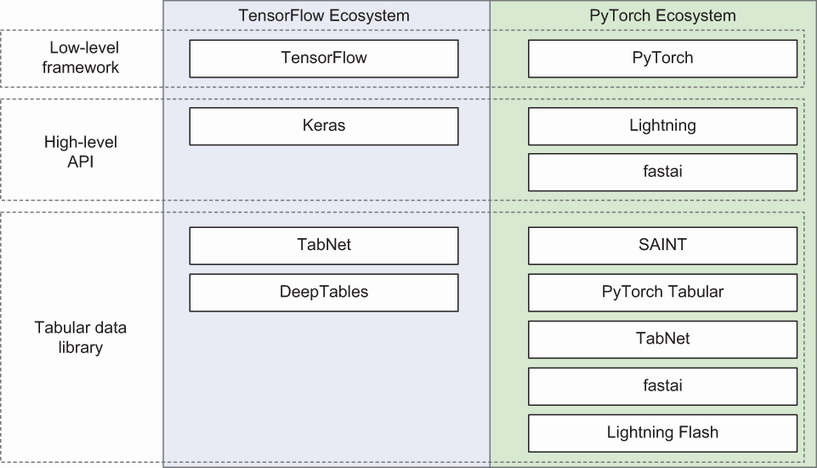
Use the stack diagram to compare how low-level frameworks, high-level APIs, and tabular libraries combine. section 8.1
