A SaaS consumer uses generative AI through a vendor-provided application or platform. The organization can start quickly with little technical setup, but depends on the vendor to operate the model and protect its data. section 2.1
The adoption posture determines where control and oversight sit. Compared with an API integrator, which connects a third-party model to its own systems, a SaaS consumer uses an existing application and has less direct control. An organization can use multiple postures across different teams. section 2.1 section 2.0
Figure 2.1 Different types of GenAI adoption. SaaS Consumers have the least control and highest vendor dependency, Model Hosters the highest control and lowest vendor dependency
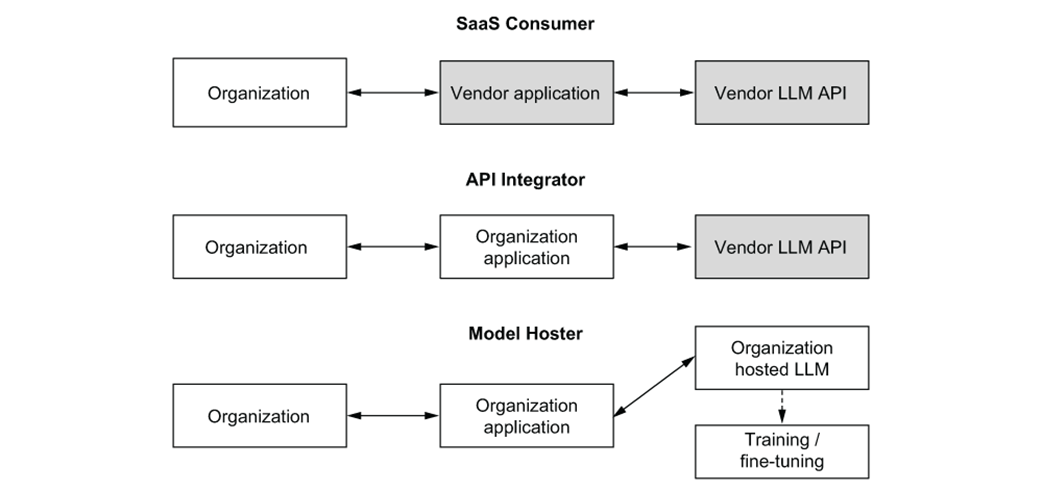
Compare SaaS consumption with other adoption postures by control and vendor dependency. section 2.1
A SaaS application may send interactions to a separate external LLM provider, creating another trust boundary. That provider can maintain its own logs of requests, outputs, usage metrics, and potentially sensitive content. The consuming organization may have little visibility into or influence over those logs. section 2.2
Use the controls available to the organization while recognizing their limits:
- Set effective prompts and manage retrieval-augmented generation (RAG) data carefully. section 2.2
- Use zero-retention options where feasible, and define vendor responsibilities for data use, sharing, and retention in contracts. section 2.2
- Account for limited control over input/output validation and logging at both the application vendor and LLM provider layers. section 2.2
Vendor-provided applications
A marketing team might use Midjourney for visuals, ChatGPT for document review, or Zoom for transcription and summarization. Each is SaaS consumption when the organization uses the vendor’s application rather than integrating or hosting the model itself. section 2.1

