liveBook · Manning

Application-level pipeline

As explained in Platform Engineering on Kubernetes

An application-level pipeline is an automated workflow that packages and publishes artifacts for an entire application.

An application-level pipeline automates packaging and publishing for an entire application rather than for one service. It complements service pipelines when services change frequently but the application structure and deployment artifact change less often. section 3.6

Choose the pipeline boundary by considering:

  • Whether services deploy individually or as a set. section 3.6
  • How often services and application definitions change. section 3.6
  • How many teams deploy the services and who consumes the artifacts. section 3.6

Conference application Helm Chart

A separate pipeline packages and publishes the Conference application Helm Chart. Teams can install the application with Helm, or render it with helm template and apply the output with kubectl. Service pipelines continue delivering the rapidly changing service code. section 3.6
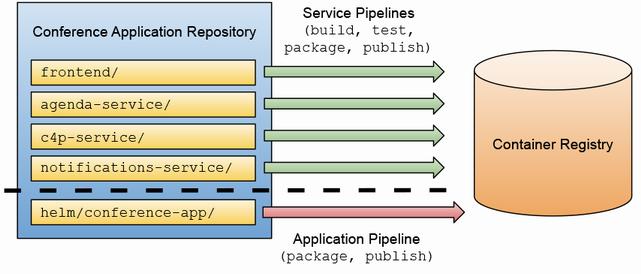
Figure 3.13 The service pipelines and the application pipeline have different lifecycles.

Compare the different lifecycles of service pipelines and the application pipeline. section 3.6

How Platform Engineering on Kubernetes covers it

How deep it goes
Explains pipeline boundaries through deployment, change cadence, team, and artifact-consumer questions, but does not detail implementation configuration.
Examples
Uses the Conference application Helm Chart, Helm installation, and rendered manifests applied with kubectl.
What you can do after
Operate application deployment through a published Helm Chart or rendered manifests applied with kubectl.
How it connects
Connects Helm Charts, service pipelines, Kubernetes clusters, helm template, and kubectl.

Related concepts

This explainer was generated by Manning's knowledge graph from the text of Platform Engineering on Kubernetes. The section links point to the parts of the book it draws on.