A sampling gap arises because benchmarks cover only a thin slice of the inputs a modern model may encounter. New capabilities and failures can surface after deployment when real inputs fall outside that slice. Because language models learn from text shaped by what people write and repeat, rare or underdescribed patterns remain weaker. section 6.2.1
Uneven performance
A model may handle multidigit arithmetic up to n digits but fail at n + 1, or retrieve information up to L tokens of context but slip at L + 1. These boundaries show why broad scores can conceal uneven capabilities. section 6.2.1
Figure 6.4 A model will learn some tasks more easily than others. Easy tasks are frequent with dense data, while hard tasks are infrequent with sparse data.
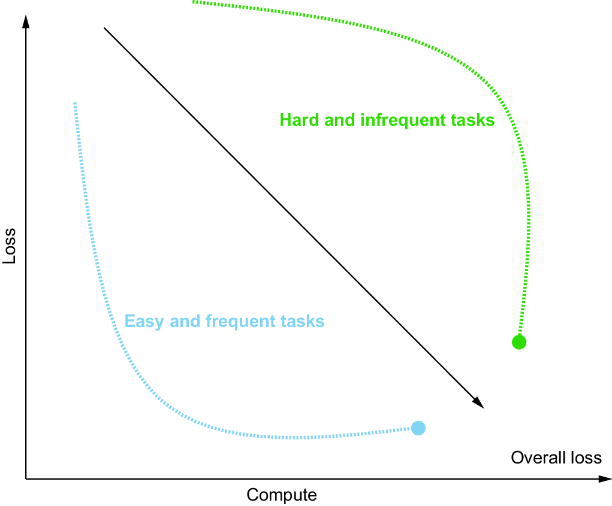
Shows how frequent tasks with dense data can be easier to learn than infrequent tasks with sparse data. section 6.2.1
