Saturation clamps a value that exceeds a numerical format’s representable range to its nearest boundary. In fixed-point arithmetic, this limits the stored result; in serving systems, a saturation point is where capacity limits begin to affect requests. section 2.1 section 12.3.2
The practical effects depend on what is saturating:
- In fixed-point quantization, values outside the grid are clipped, causing overload error; widening the grid reduces clipping but increases rounding error. section 2.6
- In model serving, freed memory can move the concurrency limit outward, but only when workload demand approaches the memory limit. section 12.3.2
Clipping in Q3.4
An 8-bit Q3.4 value has a maximum of 7.9375. Storing 10.0 clips to that boundary, as does adding two stored 5.0 values. section 2.1
Figure 12.6 KV-cache occupancy (left) and request-queue depth (right) against offered concurrency on a log-2 axis, FP16 versus AWQ. FP16 is the solid line with circle markers, AWQ the dashed line with square markers. Occupancy stays below 2% and queue depth stays at zero across the entire sweep for both formats — the system never approaches its memory limit at this model size, so the saturation knee the freed memory is meant to push outward does not appear.
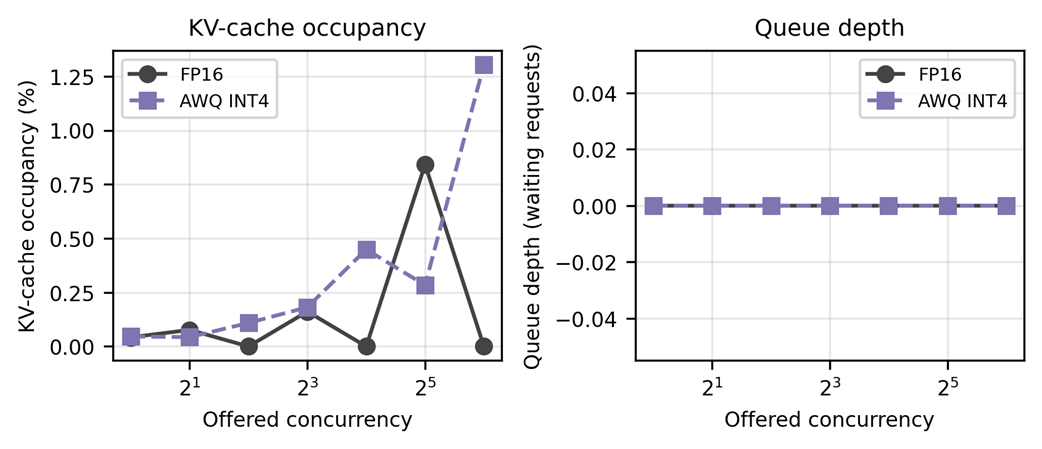
The figure compares FP16 and AWQ serving: at the tested 3B workload, the queue stays empty and KV-cache occupancy remains below 2%, so no saturation knee appears. section 12.3.2