Scaffold decoration varies substituents attached to a common molecular scaffold, creating analog libraries for property optimization and activity analysis. section 7.2.2
A practical scaffold-decoration workflow:
- Identify a core scaffold and its attachment sites. section 7.2.2
- Collect molecular fragments and define compatible reaction rules. section 7.2.2
- Enumerate analogs, then filter or prioritize them for drug-likeness, synthetic feasibility, or predicted activity. section 7.2.2
RDKit library construction
An RDKit workflow extracts Murcko scaffolds and R-groups, applies reaction SMARTS, and generates expanded analog sets; BRICS decomposition and building provide an alternative retrosynthetic route. section 7.2.2
Figure 7.8 Scaffold hopping requires identifying a new scaffold that can bear the required R-groups in the appropriate relative positions. Replacement of the benzene ring with a pyridine ring would give a similar structure, but a pyrimidine scaffold would not work since the two nitrogens won’t accommodate the necessary R-group orientation.
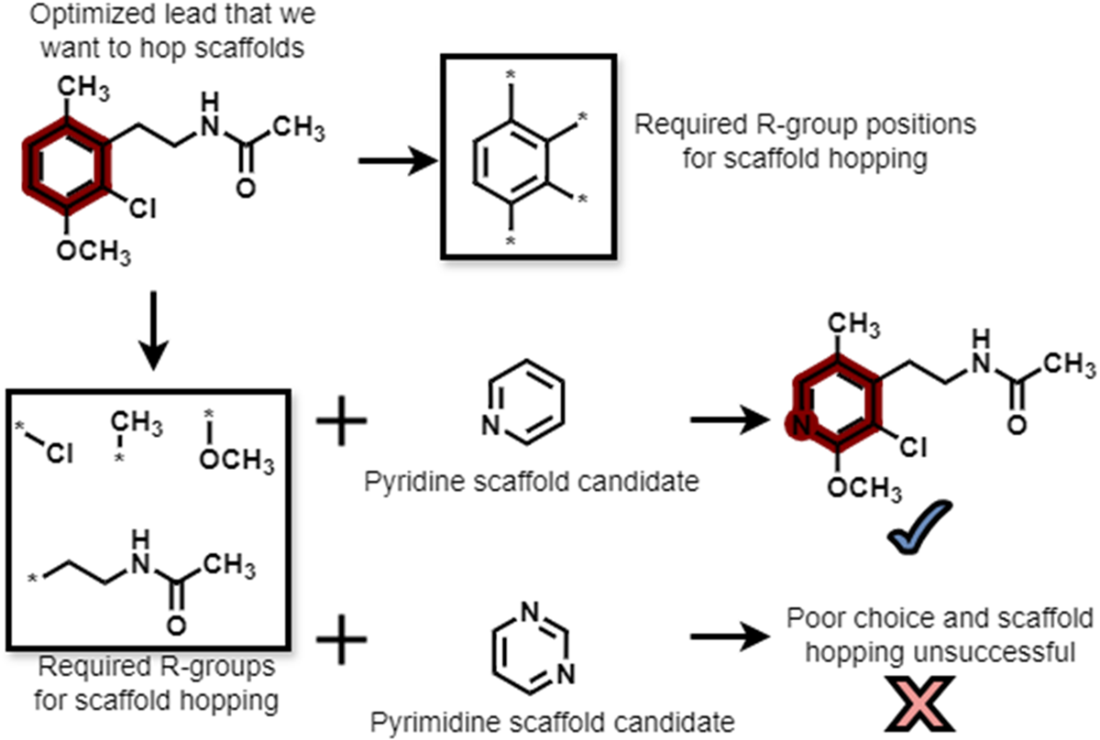
Contrast scaffold decoration with scaffold hopping: decoration retains the core, whereas hopping replaces it while preserving R-group placement requirements. section 7.2.2
