A scalar is a single number used with vectors. Multiplying a vector by a scalar multiplies every coordinate: (a1, a2) × d = (a1 × d, a2 × d). Geometrically, this scales the vector: its direction is retained while its length changes by the scalar factor. section 2.1.2 section 9.1
Scale a vector
For c = (1.5, 2), multiplying by the scalar 0.5 gives e = 0.5c = (0.75, 1). The result points in the same direction but is half as long. A vector can also be written as scaled basis vectors: (0.5, 1.5) = 0.5i + 1.5j. section 2.1.2
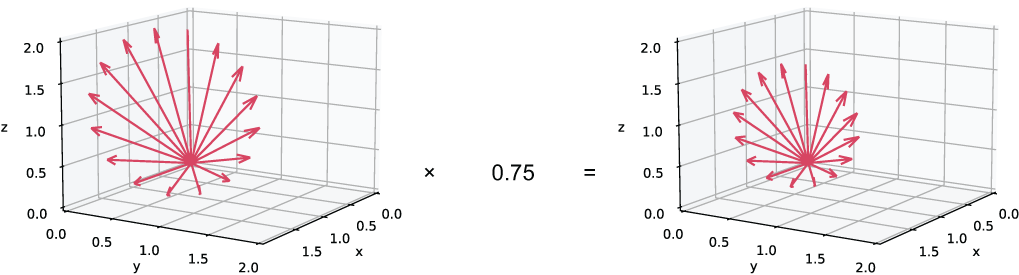
Scaling every point vector in a model by one scalar produces a geometric scaling transformation. section 9.1
Scalars help separate vector algebra from ordinary array handling. A vector may look like an array of numbers, but its algebra defines meaningful operations such as vector addition and scalar multiplication. Matrices have their own algebra as well; vectors and matrices can both be described more generally as tensors. section 2.5.2
Scalars also appear as results of vector operations:
- A dot product turns two vectors into a scalar. For (2, 3, 4) · (5, 6, 7), the scalar result is 2×5 + 3×6 + 4×7 = 56. section 9.2.1
- A triple product takes three vectors and produces a scalar, unlike a cross product, which produces a vector. section 9.1
- A scalar k can scale a perpendicular vector: if a = (xa, ya), then (kya, -kxa) is orthogonal to a. section 5.3.2
In applied geometry, scalar multiplication is useful because it turns algebra into a direct transformation: add one vector to all point vectors to translate a model, or multiply all point vectors by a scalar to scale it. Dot products then provide scalar values for tasks such as expressing orthogonality and reasoning about projections. section 9.1 section 5.3.2 section 9.2.1



