liveBook · Manning

Scattering

As explained in Acing the CCNA Exam: Volume 2 Advanced Networking and Security

Scattering is the redirection of a propagating electromagnetic wave by irregularities or small objects in its medium.

Scattering redirects a propagating electromagnetic wave when it encounters irregularities in a surface or medium, spreading the wave’s energy erratically in multiple directions. section 18.1.2

In wireless LANs, scattering matters because it:

  • Disperses signal energy and can cause attenuation, weakening the signal available to the receiver. section 18.1.2
  • Appears alongside absorption, reflection, refraction, and diffraction as a factor shaping wireless coverage and reliability. section 18.1.2 section 18.1.1
  • Can result from dust, smog, water vapor, and textured surfaces encountered by the signal. section 18.1.2
Figure 18.4 Phenomena affecting the behavior of electromagnetic waves include absorption by a medium, reflection off surfaces, refraction (bending) as waves pass through a medium, diffraction around obstacles, and scattering from irregularities.
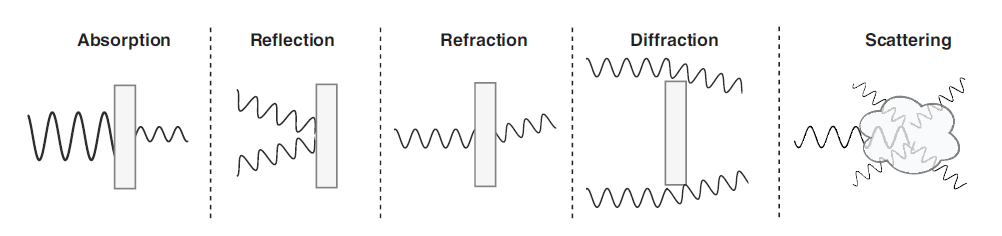
Use the comparison figure to distinguish scattering from absorption, reflection, refraction, and diffraction. section 18.1.2

How Acing the CCNA Exam: Volume 2 Advanced Networking and Security covers it

How deep it goes
Defines the phenomenon, identifies causes and attenuation, and stops short of detailed wireless LAN design calculations.
Examples
Uses dust, smog, water vapor, textured surfaces, and irregular media as scattering examples.
What you can do after
Evaluate how irregularities can disperse wireless signal energy and weaken reception.
How it connects
Links scattering with absorption, reflection, refraction, diffraction, signal attenuation, free-space path loss, and wireless coverage.

This explainer was generated by Manning's knowledge graph from the text of Acing the CCNA Exam: Volume 2 Advanced Networking and Security. The section links point to the parts of the book it draws on.