Why can a program create thousands of temporary objects without much garbage-collection cost, while retaining a small fraction of them causes pauses to grow? In V8, the Scavenger collects the young generation by copying objects that are still reachable. Dead objects are not individually freed; they are left behind when collection finishes. The crucial cost is often survival, not allocation. section 9.2.2 section 9.4.1
New objects enter the active semi-space, called from-space. When it fills, a minor GC begins. The Scavenger starts at roots and the remembered set, traces reachable young objects, and copies them into the other semi-space, to-space. After copying, it swaps the semi-space labels. The old from-space can be reused without visiting its dead objects; the copied survivors sit together without fragmentation. Work is therefore proportional to survivors rather than to every object allocated. section 9.2.2
Figure 9.4 During a scavenge, V8 traces live objects in from-space and copies them into to-space. Dead objects are never visited. Once copying is complete, the semi-space labels swap: the old from-space is abandoned and the old to-space becomes the new from-space for future allocations.
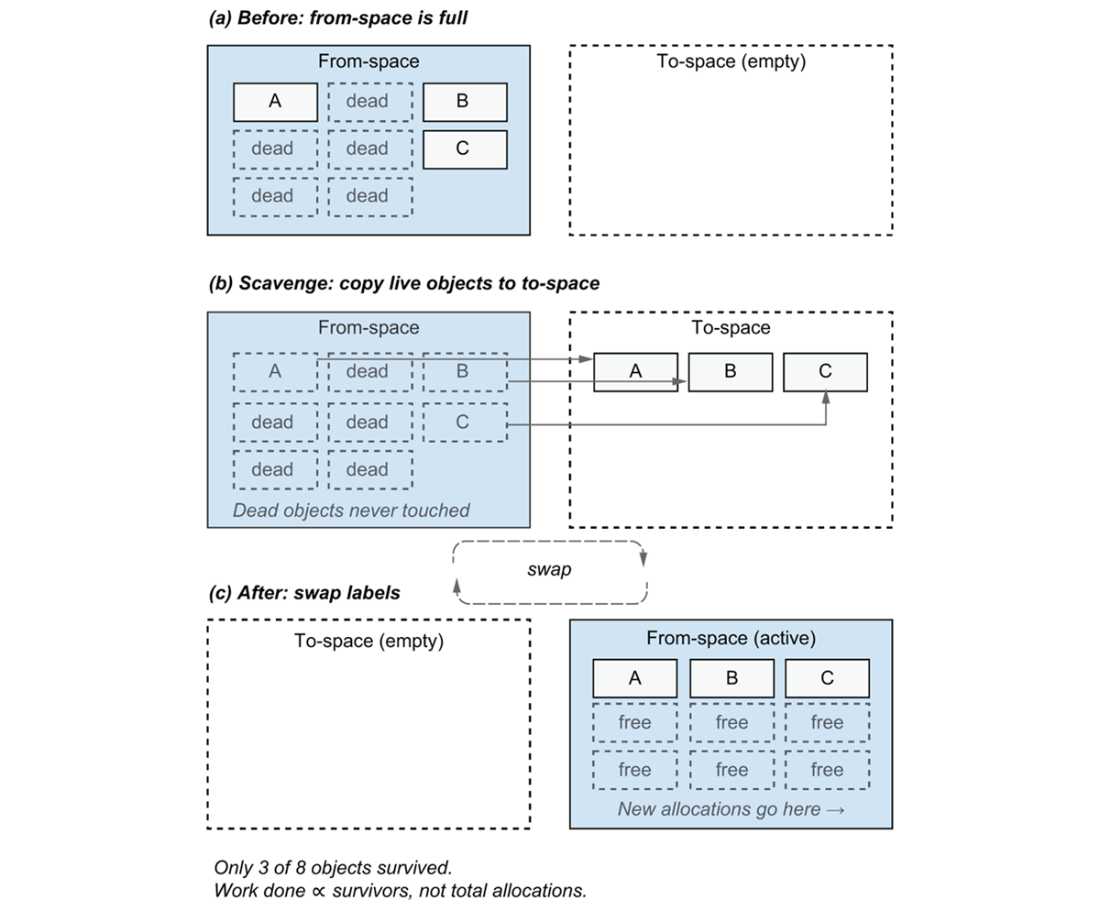
Follow the live objects across the two semi-spaces, then note that the labels swap while dead objects remain untouched. section 9.2.2
There is a catch: a young object can be reachable through an old-generation object, even though a minor GC does not scan the old generation. V8’s write barrier detects an old-to-young reference stored in a property and records it in the remembered set. The Scavenger treats those recorded references as additional tracing roots. That preserves reachable objects, but adds bookkeeping to property writes on long-lived objects. Objects that keep surviving scavenges can eventually be promoted, shifting collection work toward the old generation. section 9.2.4 section 11.2.5
Same allocation rate, different lifetime
Imagine a request creating 5,000 response objects. If it returns only a count, those objects can die young. If it stores a slice of the response in a persistent cache on every request, some remain reachable. The two versions create the same objects per request, yet retaining them changes the GC profile: Scavenges alone can give way to growing old-generation collections and longer pauses. An intermediate array from a filter/map chain, by contrast, may die young and be handled efficiently; replacing every chain with a loop is not automatically an improvement. section 9.2.4 section 9.4.1
When Scavenges appear in a profile, distinguish frequency from survival:
- Frequent effective Scavenges can mean high allocation volume: the young generation fills quickly even though most objects die young. section 11.2.5
- Regular Mark-Compact events under load suggest objects are surviving into the old generation. Examine retained objects rather than assuming the number of allocations is the problem. section 11.1.5 section 11.2.5
- Keep an eye on closures captured by promises, timers, and event listeners; they can extend object lifetimes. Profile under realistic load before rewriting readable code. section 9.4.2
This is a V8 collector, not a JavaScript-language rule or a description of every runtime. On Node.js, `--trace-gc` labels young-generation collections `Scavenge` and reports heap sizes and pause durations. Browser DevTools exposes GC events in a timeline instead of the same text log; JSC-based runtimes do not provide V8’s continuous `--trace-gc` view. section 11.1.5
