Schema extraction identifies raw knowledge-graph schema structures and converts them into formats that large language models can process for natural-language querying. Enriching the extracted schema with useful metadata can make expert reasoning more accessible to nontechnical users. section 14.6
A practical extraction stage follows this sequence:
- Require a configured Neo4jSchema object before processing. section 15.1.5
- Retrieve the current graph schema and apply configured settings. section 15.1.5
- Serialize the configured schema into a string for downstream language-model prompts. section 15.1.5
- Initialize a retry counter so later query execution can recover from failures. section 15.1.5
Schema extraction agent
The agent calls get_schema(), applies configuration, and returns {"schema": str(self.neo4j_schema), "retries": 0}. The resulting state feeds a text-to-Cypher agent, which uses the schema alongside the user’s question and selected graph elements. section 15.1.5
Figure 14.7 Schema processing pipeline, highlighting the transformation of the database schema into LLM-compatible formats. The diagram illustrates how raw schema structures are processed through schema extraction to create representations that LLMs can effectively process.
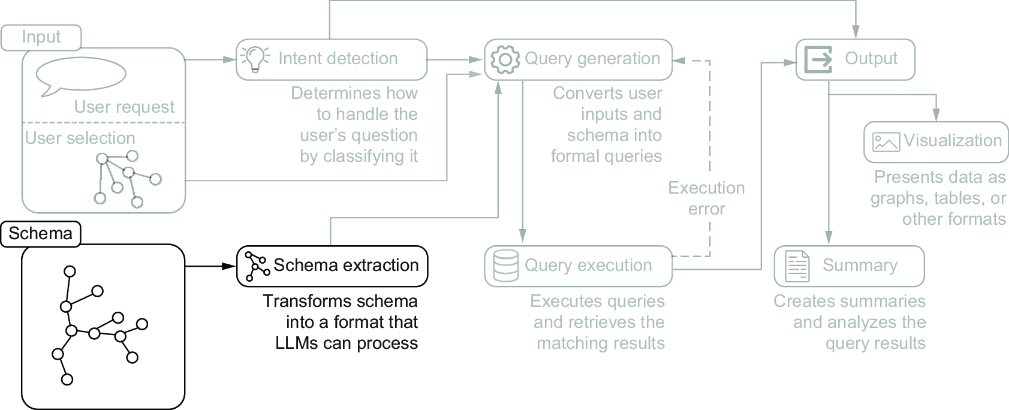
The pipeline diagram shows raw database schema structures being transformed through extraction into representations suitable for large language models. section 14.6
