Kafka brokers store messages as bytes; they do not inspect a message or enforce its structure. A schema registry supplies the missing shared contract. It stores formal definitions of event data separately from brokers so producers and consumers can agree on message structure without a direct dependency on each other. section 1.5.1
The contract travels by identifier, not by copying the schema into every message:
- A schema is registered and assigned an ID. Changes create new, immutable versions, which clients can cache. section 1.5.1
- A configured producer serializes the data and includes the schema ID in the message. A configured consumer uses that ID to retrieve the schema and deserialize the data. section 6.4.1
- Compatibility checks help govern changes between versions, but they do not make Kafka brokers validators: clients remain responsible for using schemas correctly. section 6.7
Figure 6.12 Interactions with the Schema Registry. The schema is registered with the Schema Registry server, which stores it in Kafka. Producers use this schema to serialize messages, and consumers retrieve the schema from the Schema Registry to deserialize messages.
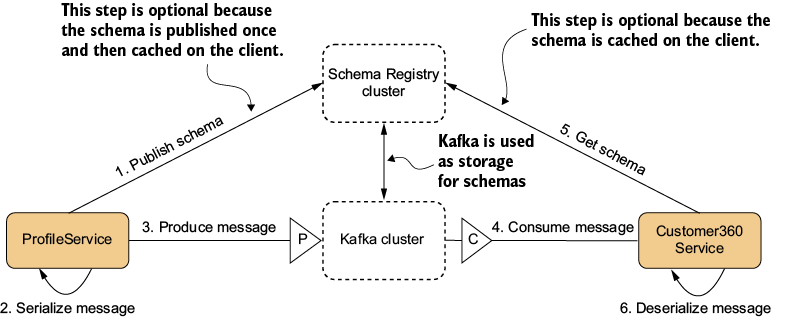
The interaction diagram separates schema registration and retrieval from Kafka message delivery: the registry stores schemas in Kafka, while producers and consumers use them to serialize and deserialize events. section 6.4.1
Operationally, the registry exposes an HTTP REST API for registering and retrieving schemas and checking compatibility. It runs as a cluster for failover and persists schema data in a compacted Kafka topic named _schemas by default. Supported formats here are Avro, JSON Schema, and Protobuf; clients need matching format-aware serializers or deserializers and a registry URL. section 6.1 section 6.4.1
Choosing a registration path
A producer can register a compatible new version automatically, or a team can register it through the REST API before release. Manual registration better fits a controlled release process. Confluent Platform clients can disable automatic registration with auto.register.schemas=false and configure use.latest.version=true to look up the latest version in a subject. section 6.4.2
Central management does not eliminate migration work. Renaming fields, changing types, or restructuring entities may exceed a compatibility mode and require a planned transition. Schema IDs can also differ between environments, complicating transfer between Kafka clusters. Distributing schemas and custom serializers in client libraries is an alternative, but it shifts coordination to clients and can limit integration with message-browsing tools. section 6.4.6


