Schema validation checks authorization policies against declared principal types, resource types, actions, and attributes before those policies can be merged or deployed. It turns naming and data-model assumptions into enforceable constraints rather than relying on runtime discovery. section 10.2.1 section 10.2.4
A practical validation workflow:
- Define valid principals, resources, actions, and modeled attributes in a shared schema. section 10.2.1
- Type-check policies during pull requests and reject references to unknown actions or attributes. section 10.2.1 section 10.2.4
- Combine schema validation with static analysis and behavioral tests for expected allow and deny cases. section 10.1.5 section 10.2.4
- Use validation failures to correct policy design and clarify where organizational data belongs. section 10.2.1
Rejecting an unmodeled department check
A deployment policy tested principal.department == "Engineering", but the schema did not model department as a principal attribute. Validation rejected the condition, prompting a switch to modeled engineering-manager and senior-engineer roles in the entity store. section 10.2.1
Figure 10.6 Continuous integration for policies. Bob’s pull request triggers validation, analysis, and testing. After the checks pass, his changes are merged, bundled into a signed package, and published to a policy store, where the authorizer uses them to evaluate requests at runtime.
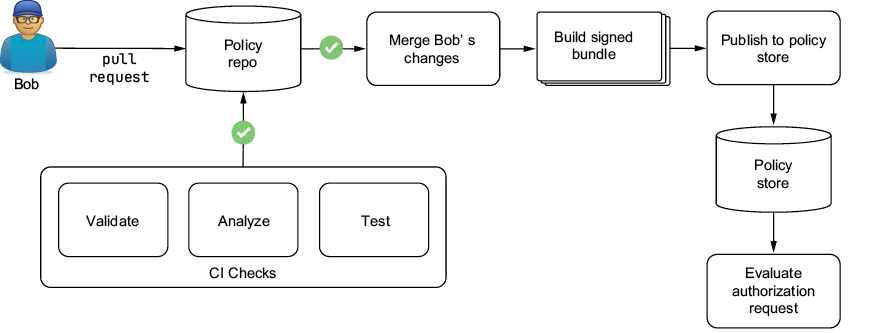
Trace schema validation through a continuous-integration pipeline: pull-request checks run before reviewed policies become signed bundles in the runtime policy store. section 10.2.4






