liveBook · Manning

SCM equivalence class

As explained in Causal AI

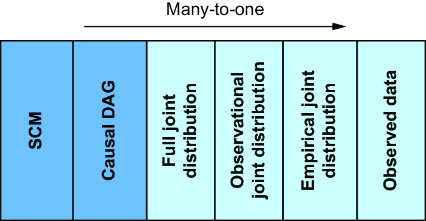
An SCM equivalence class is a set of structural causal models that are consistent with the same causal DAG and joint probability distribution.

An SCM equivalence class is the set of structural causal models consistent with both a causal DAG and the same joint probability distribution. Different assignment functions or exogenous distributions can therefore produce identical observed distributions. Data alone cannot determine which member is the ground-truth SCM without additional causal assumptions. section 6.2.2

Marked-stick die models

For die choice X causing die roll Y, multiple stick-breaking constructions can match P(X) and P(Y|X). With three outcomes, six orderings of the marked stick yield six possible SCMs, while repeated observed rolls cannot reveal which ordering generated them. section 6.2.2

Figure 6.16 Different SCMs can entail the same DAG structure and distributions. The SCMs can differ in assignment functions (and/or exogenous distributions).
figure

Compare SCMs that share a DAG and distributions while differing in assignment functions or exogenous distributions. section 6.2.2

How Causal AI covers it

How deep it goes
Explains equivalence through DAGs, distributions, assignment functions, exogenous distributions, and a die-roll construction.
Examples
Uses stick-breaking die-roll models with six possible outcome orderings and repeated observed rolls.
What it assumes
Assumes causal DAGs, structural causal models, joint distributions, and Markov equivalence classes.
What you can do after
Evaluate why observational data alone cannot recover a ground-truth SCM without causal assumptions.
How it connects
Connects structural causal models with causal DAGs, Markov equivalence classes, joint distributions, and causal identifiability.

Related concepts

This explainer was generated by Manning's knowledge graph from the text of Causal AI. The section links point to the parts of the book it draws on.