Search interest measures how popular a term or topic is relative to itself over a chosen time and location. Google Trends normalizes results from 0 to 100, where 100 marks the peak. section 7.4.1
Use search interest as a decision aid, not as the only reason to choose a keyword:
- Compare topics with topics and search terms with search terms. section 7.4.1
- Check several years of data to reveal trends and seasonal spikes. section 7.4.1
- Inspect related topics and queries for better alternatives or irrelevant results. section 7.4.1
- Prefer a more relevant phrase when its audience matches the content, even if its search interest is lower. section 7.4.1
Choosing between similar terms
“Streaming data” has higher apparent interest than “event streaming,” but “event streaming” may better fit an article about publish–subscribe, event sourcing, and CQRS. Related queries can also reveal that “event streaming” includes searches about livestreamed events. section 7.4.1
Figure 7.6 Google Trends result for comparing interest in two similar search terms: event streaming and streaming data. There seems to be significantly higher interest in streaming data.
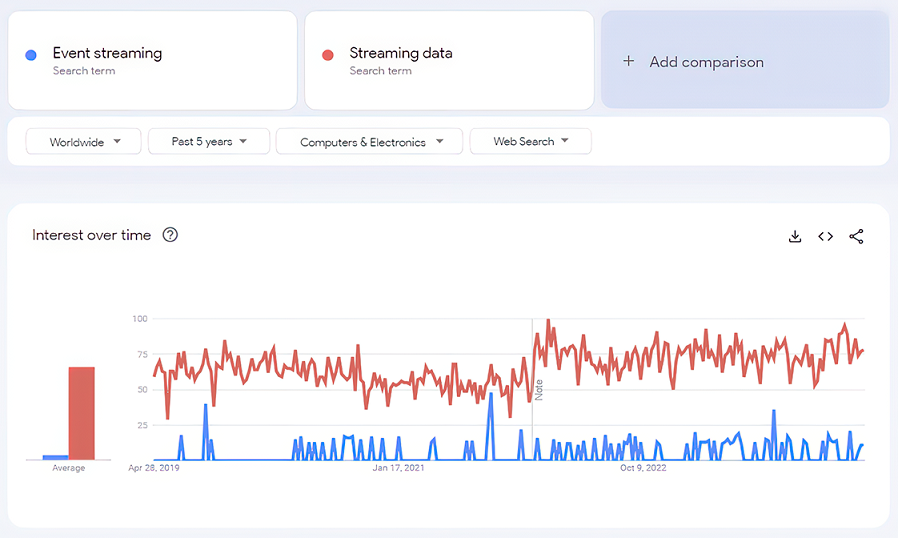
Compare the relative Google Trends interest of “event streaming” and “streaming data” before choosing a focus term. section 7.4.1
