A search landscape lays out reachable candidates and gives each one a height based on its score. High points are strong candidates; low ground is weak. A search is a rule for choosing which candidate to try next. section 4.1.3
Greedy search moves only to a better neighbor. It can stop at a local optimum: a candidate better than every neighbor, but worse than a more distant candidate. Reaching that better candidate may require moving downhill first. section 4.1.3
Keeping candidates or their history changes how a search can cross a valley:
- A population spreads candidates across the landscape, so some may already be in the valley and able to climb toward a farther peak. section 4.1.3
- An archive retains points it has seen, including low-scoring valley points, and can use them to reach a peak that greedy search cannot. section 4.3.4
Figure 4.11 The valley is a wall for greedy and a bridge for the archive. The greedy climber (solid) walks up to the local peak and halts, since every neighbor from there is lower. The archive (hollow markers on every point) keeps the low valley points it passed through, so the dip is something to cross rather than a wall, and it reaches the taller global peak the climber never saw.
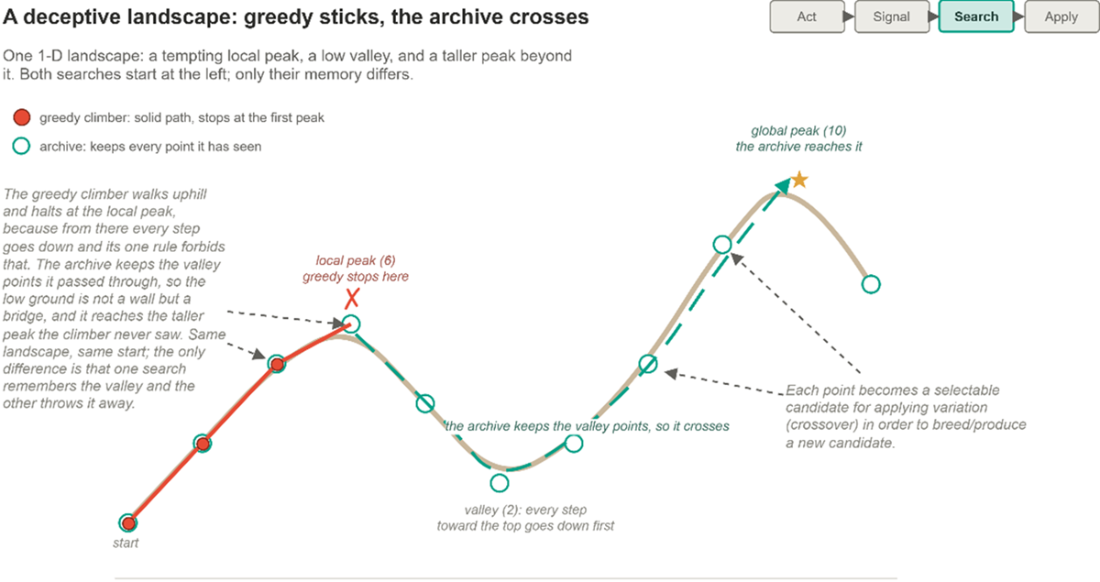
Compare the greedy path, which stops at the local peak, with the archive’s path across the valley to the taller peak. section 4.3.4
A deceptive landscape
In a toy landscape, greedy search stops at height 6, while archive search reaches height 10 by retaining points across the valley. section 4.3.4