Secondary structure is the second level of protein organization: a local, regular arrangement adopted by short backbone segments as a protein chain folds. Nearby amino acids stabilize these repeating geometries mainly through hydrogen bonds. The principal forms are alpha-helices, where the chain coils into a right-handed helix, and beta-strands, where it extends into an elongated conformation. section 12.1.1
Place secondary structure within the protein-structure hierarchy:
- Primary structure is the linear amino-acid sequence. section 12.1.1
- Secondary structure comprises local helices, strands, and the irregular loops connecting them. section 12.1.1
- Tertiary structure describes how these elements pack into a complete three-dimensional protein fold. section 12.1.1
Figure 12.3 Primary structure is the linear sequence of amino acids. Secondary structure is local backbone geometry—chiefly alpha-helices and beta-strands—stabilized largely by backbone hydrogen bonding. Tertiary structure is the full three-dimensional arrangement of a single polypeptide chain, including how its secondary-structure elements and connecting loops pack together. Quaternary structure describes an assembly of more than one chain.
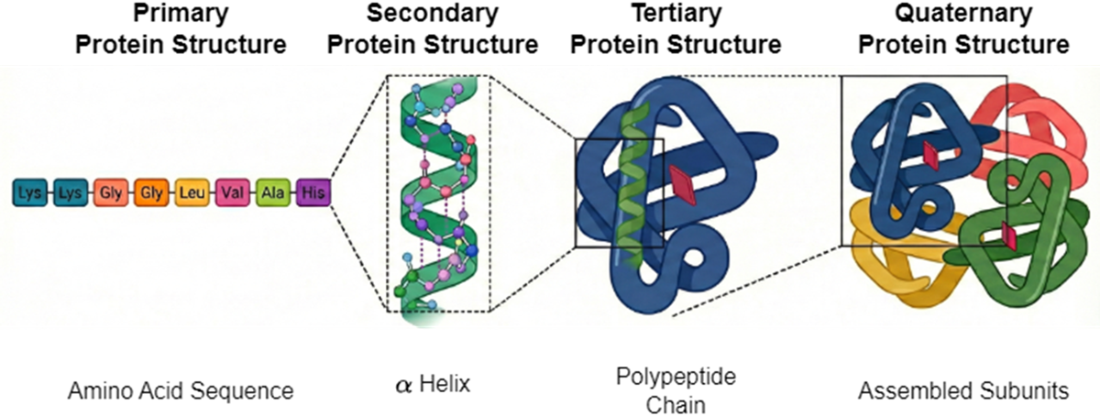
Use the structural hierarchy diagram to distinguish sequence, local backbone geometry, whole-chain folding, and multichain assembly. section 12.1.1
