liveBook · Manning

Secret share

As explained in Real-World Cryptography

A secret share is a portion of a secret distributed to a participant in a secret-sharing scheme.

A secret share is one partial piece of a secret, such as a symmetric key or signing private key. A dealer creates the shares, distributes them, and deletes the original secret. section 8.8

A typical secret-sharing process has three practical stages:

  • Split the secret into multiple private shares. section 8.8
  • Return the shares to the dealer when the secret is needed for encryption, signing, or another operation. section 8.8
  • Reconstruct the original secret from the collected shares; an individual share is useless by itself. section 8.8

A geometric intuition

Treat the secret as a polynomial. Two points recover a line, while three points recover a quadratic curve; random points become the partial keys. section 8.8

Figure 8.11 Given a key and a number of shares n, the Shamir’s Secret Sharing scheme creates n partial keys of the same size as the original key.
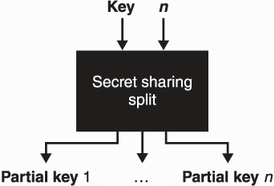
Visualizes how one key becomes multiple partial keys of the same size. section 8.8

How Real-World Cryptography covers it

How deep it goes
Explains dealer workflow and polynomial intuition, while omitting algorithmic implementation details.
Examples
Uses symmetric keys, signing private keys, polynomial curves, and arithmetic-circuit inputs as examples.
What it assumes
Assumes basic cryptographic operations and introduces secret splitting through plain-language examples.
What you can do after
Apply Shamir’s Secret Sharing to distribute and later reconstruct a cryptographic secret.
How it connects
Connects secret sharing with threshold cryptography, cryptographic keys, and multiparty computation.

Related concepts

This explainer was generated by Manning's knowledge graph from the text of Real-World Cryptography. The section links point to the parts of the book it draws on.