A device may need to keep a secret safe even when its main processor or surrounding software is attacked. A secure element is a small, separate, tamper-resistant hardware component that protects secrets and performs cryptographic operations as a coprocessor for a larger system. section 13.2.2 section 13.5
Secure elements appear in several forms and support different practical needs:
- Use a pluggable form, such as a phone SIM card, or bond the component directly to a chip or motherboard, such as an iPhone NFC payment element. section 13.2.2
- Treat the secure element as a hardware security choice for connected devices including payment cards, phones, biometric passports, garage keys, and smart-home sensors. section 13.2.2
- Choose among form factor, cryptographic speed, and required security; certifications and vendor claims describe different software and hardware protections. section 13.3
- Remember that hardware raises attack cost rather than making compromise impossible, and design systems so one compromised device does not expose every device. section 13.3
A phone payment element
An embedded secure element attached to a phone’s NFC chip can protect payment secrets and support cryptographic operations while the phone’s main system performs the broader application work. section 13.2.2
Figure 13.4 The different hardware solutions you learned in this chapter and an idea of what they look like.
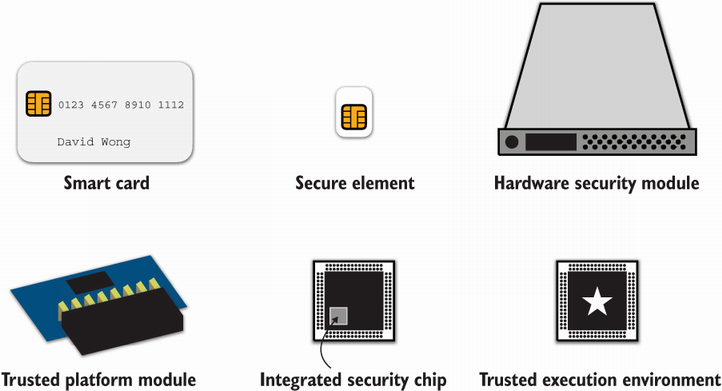
Compare secure elements with smart cards, HSMs, TPMs, security processors, and TEEs by their form, placement, programmability, speed, and security role. section 13.3
