A security objective is a desired protection property for information or digital entities. Cryptography commonly targets confidentiality, integrity, and authenticity: hiding sensitive data, preventing alteration, and preventing impersonation. section 1.1
The lockbox model
Confidentiality resembles shipping an impenetrable lockbox: observers can see its destination but cannot read its contents without the specific key. Digital cryptography applies the same intuition to messages traveling as internet packets, while integrity and authenticity provide evidence against tampering or impersonation. section 1.1
Treat the objective as an engineering requirement, not merely a mathematical property:
- Map each system requirement to the protection property it needs: secrecy, resistance to alteration, or resistance to impersonation. section 1.1
- Inspect implementations as carefully as the underlying theory; subtle coding failures can defeat the intended objective. section 1.3
- Avoid relying on privately written cryptographic implementations when established guidance warns that implementation flaws commonly break security. section 1.3
A failed objective
A gaming console could require only approved software, yet faulty random-number generation in a key operation enabled recovery and publication of a critical private key. The failure was in implementation rather than cryptographic theory. section 1.3
Figure 1.1 Security goals of cryptography
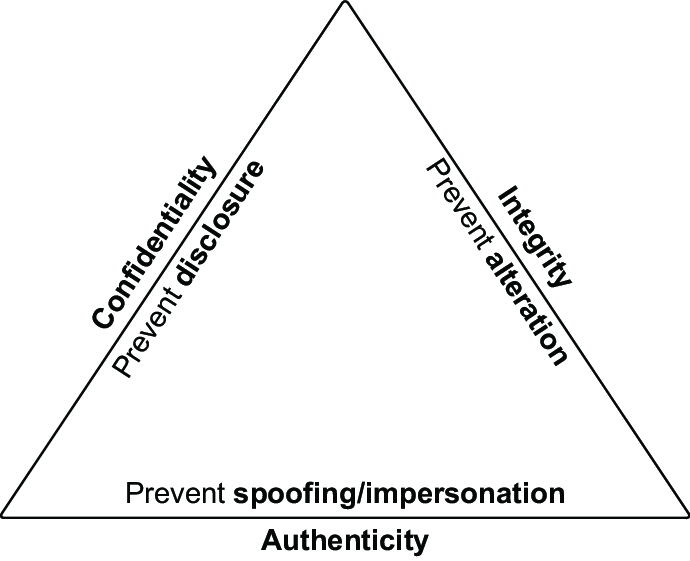
Use the security-goals figure to compare confidentiality, integrity, and authenticity as distinct protection targets. section 1.1
