Selectivity measures how strongly a compound binds to its intended target relative to other proteins or biological targets. High selectivity can reduce unintended effects on organs and biological processes, making it an important lead-optimization property alongside potency, safety, and bioavailability. section 1.4.2
Kinase selectivity is difficult because ATP-binding sites are highly conserved across the kinase family. An inhibitor aimed at one kinase may therefore inhibit many others; its cross-reactivity profile helps interpret efficacy and potential toxicity. section 11.1.1
Selectivity connects to practical discovery decisions:
- Lead optimization improves selectivity while retaining a compound’s core molecular structure and also considers potency, efficacy, safety, and ADMET properties. section 1.4.2
- A selectivity profile records how a molecule behaves across multiple targets rather than measuring only its intended interaction. section 11.1.1
DAVIS kinase-selectivity benchmark
The DAVIS dataset experimentally screened 72 kinase inhibitors against 442 kinases, producing 30,056 drug–target pairs. It records binding affinity as Kd in nanomolar units; machine-learning workflows convert Kd to pKd, where higher values indicate stronger binding. Comparing one inhibitor across kinases makes its selectivity and cross-reactivity visible. section 11.1.1
Figure 11.2 Distribution of pKd Affinity Values in the DAVIS Dataset and KIBA scores in the KIBA Dataset. For the DAVIS dataset, we observe a very large, sharp peak visible at the y-value of 5, with a much smaller, broader distribution of values between 6 and 10.
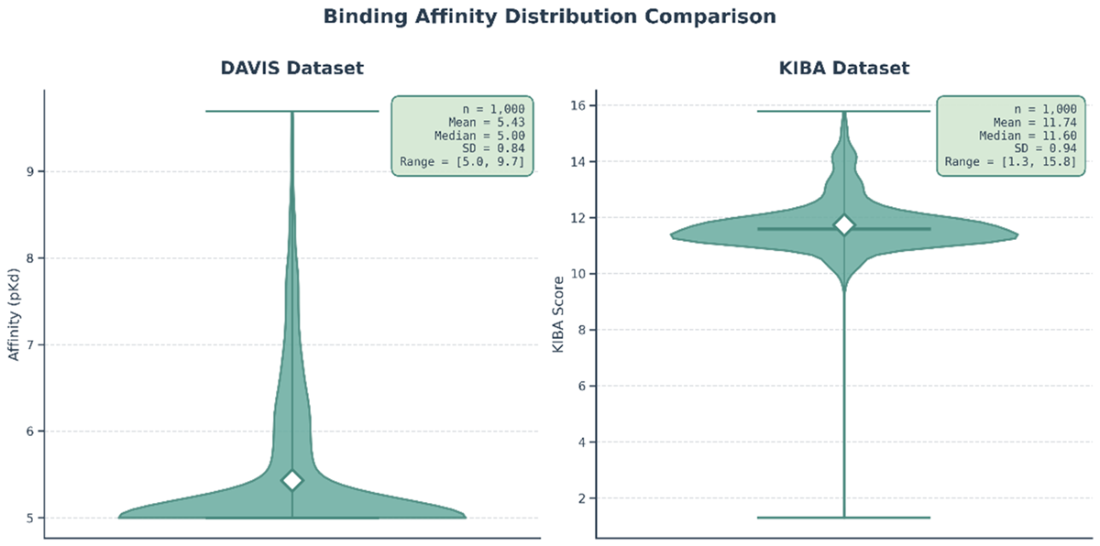
Use the affinity-distribution figure to inspect the concentration of DAVIS pKd values and the broader range of measured binding strengths. section 11.1.1
