Self-correction is the capability to evaluate generated outputs and retrieved information, detect quality gaps, and trigger corrective actions before an answer reaches the user. In retrieval-augmented generation, it turns a one-shot pipeline into a feedback loop: assess the evidence or draft, then retrieve again, revise the plan, or continue searching when support is insufficient. section 1.5.4 section 11.1
A self-correcting system can:
- Score confidence in an answer or intermediate result. section 1.5.4
- Verify factual claims and detect missing information. section 1.5.4
- Decide whether to retrieve, what to retrieve, and whether another retrieval cycle is needed. section 11.1
- Loop back to planning or retrieval instead of returning a silently failed or hallucinated answer. section 11.1
Financial compliance assistant
A compliance assistant retrieves evidence for a regulatory question, checks whether the answer covers all required parts, and searches again when evidence is incomplete, stale, poorly ranked, or insufficiently specific. This makes corrective retrieval a response to identifiable production failure modes rather than an assumption that more complexity is always better. section 11.1
Figure 11.1 From Passive Pipelines to Agentic Loops: The shift from linear execution to cyclical evaluation.
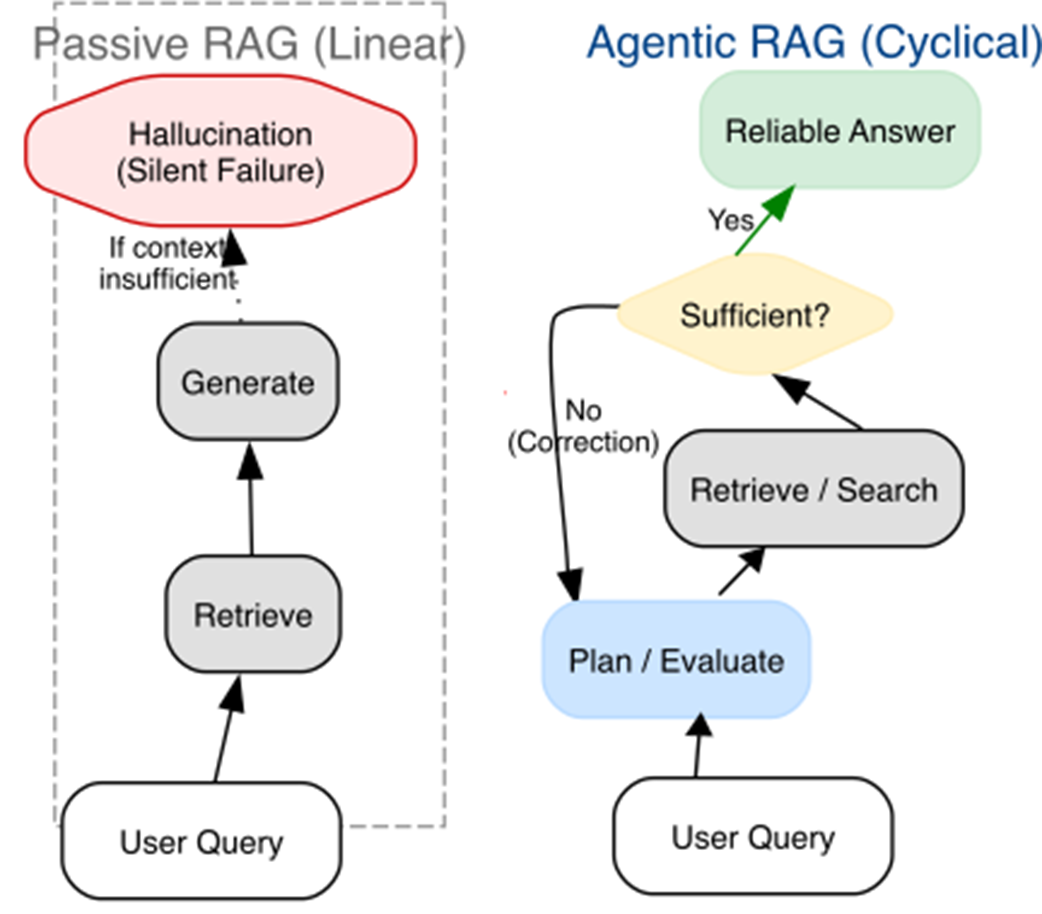
Use the diagram to compare passive one-query/one-answer execution with cyclical evaluation and correction. section 11.1
