A semantic layer is a governed modeling layer between data sources and consumers. It defines shared business entities, dimensions, relationships, metrics, calculations, and usage rules so teams interpret data consistently across tools and sources. section 8.1.2 section 8.2.2
In a federated lakehouse, the layer provides a stable abstraction over systems with different schemas, freshness, and granularity. It turns raw or federated tables into discoverable, business-ready datasets without requiring data duplication. section 2.7.4 section 8.2
A production semantic layer typically provides:
- Reusable views or virtual datasets that encapsulate joins, filters, calculations, and other business logic. section 8.2.2
- Versioning, governance, access controls, catalogs, metadata, lineage, tagging, and classification for semantic definitions. section 8.1.2 section 8.2.2
- Common interfaces for BI tools, notebooks, machine learning workflows, and AI agents. section 9.1.1 section 9.2.2
- Central enforcement of row-level security, column masking, and policy-aware access across federated sources. section 4.4.4 section 9.2.1
One revenue definition across tools
A revenue metric can join multiple datasets, apply currency conversions, and exclude returns once. Dashboards, notebooks, and reports then reuse the same definition; a later tax-rule change can be propagated centrally. section 8.2.2
Federated consumption architecture
A regulated organization can let teams use Tableau, Power BI, or Excel while a shared semantic layer exposes governed metrics through JDBC or ODBC. Trino or Dremio queries Iceberg tables, applies access policies, and supports auditable consumption. section 9.5.2 section 9.2.2
Figure 8.3 By taking data from across the organization and creating universally defined metrics and views, you can enable consistent use of the data for AI and BI.
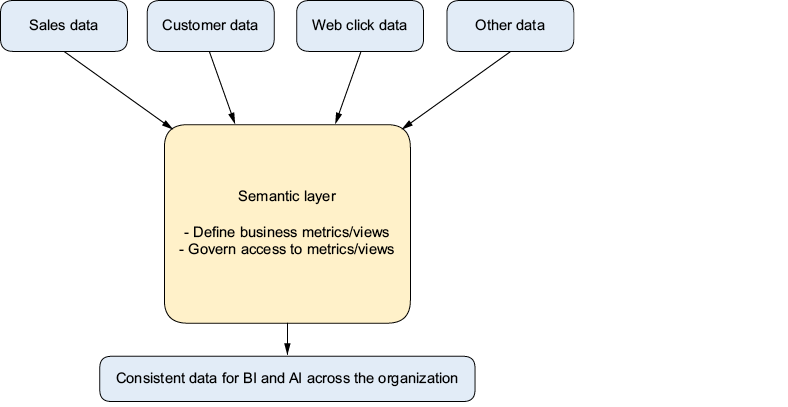
The figure connects organization-wide data with universally defined metrics and views for consistent BI and AI use. section 8.2.2
