Semantic similarity measures related meaning rather than exact term overlap. Two documents can share no explicit words yet remain similar when their terms repeatedly occur in related contexts. section 4.6.2
Latent semantic analysis addresses this blind spot by grouping co-occurring terms into topics. Geometrically, each topic is a linear subspace or direction in document-feature space, and topic-based similarity compares documents through these directions. section 4.6.2
The treatment connects semantic similarity to:
- Direct overlap: cosine similarity can miss secondary evidence carried by related terms. section 4.6.2
- Topic discrimination: useful topics show high variance across document vectors and distinguish documents in the corpus. section 4.6.2
- Dimensionality reduction: topics correspond to selected principal components after pruning components with insufficient variance. section 4.6.2
Gun and violence
Documents d5 and d6 have little or no direct overlap, yet documents containing gun can resemble documents containing violence because those terms co-occur elsewhere. Topic-based comparison captures this relationship. section 4.6.2
Figure 4.6 Document vectors from our toy dataset d0, ⋯ d6. Each word in the vocabulary corresponds to a separate dimension. Dots show projections of document feature vectors on the plane formed by the axes corresponding to the terms gun(s) and violence.
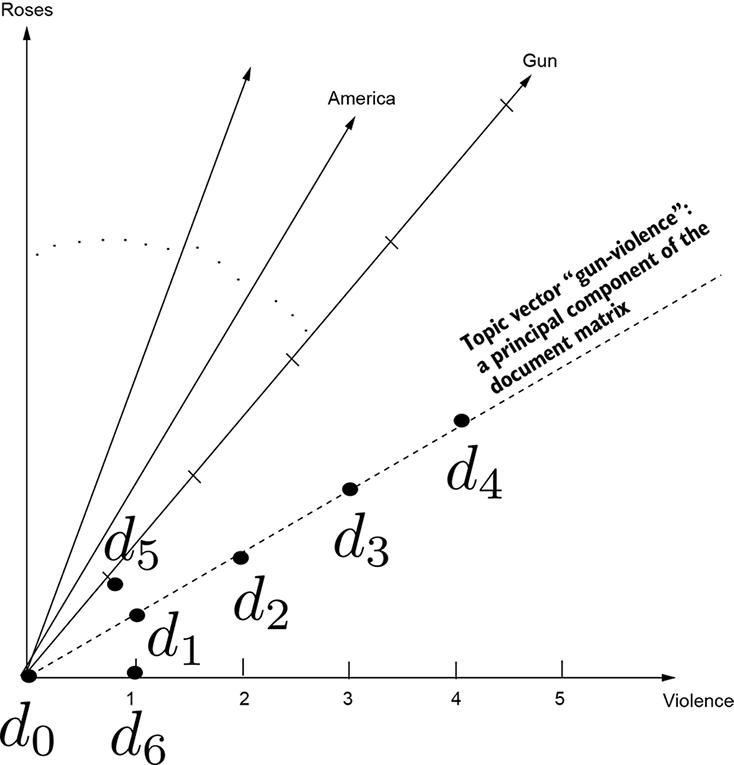
Inspect the document-vector projection to see how vocabulary dimensions and topic directions support similarity judgments. section 4.6.2




