Semiotics studies how signs and symbols convey and acquire meaning. For language models, it offers a lens for understanding how signs, signifiers, and abstractions support meaningful-looking output while exposing the limits of human-like interpretation. section 2.1.2 section 2.0
Figure 2.2 A recursive Peircean semiotic triangle is a system of organizing the process of extracting meaning from anything—in our case, from language. Each point on the triangle illustrates one of the minimal parts needed to synthesize meaning within whatever the system is being used to describe, so each point is a minimal unit in meaning for language. Firstness, secondness, and thirdness are not points on the triangle; instead, they are more like markers for the people versed in semiotics to be able to orient themselves in this diagram.
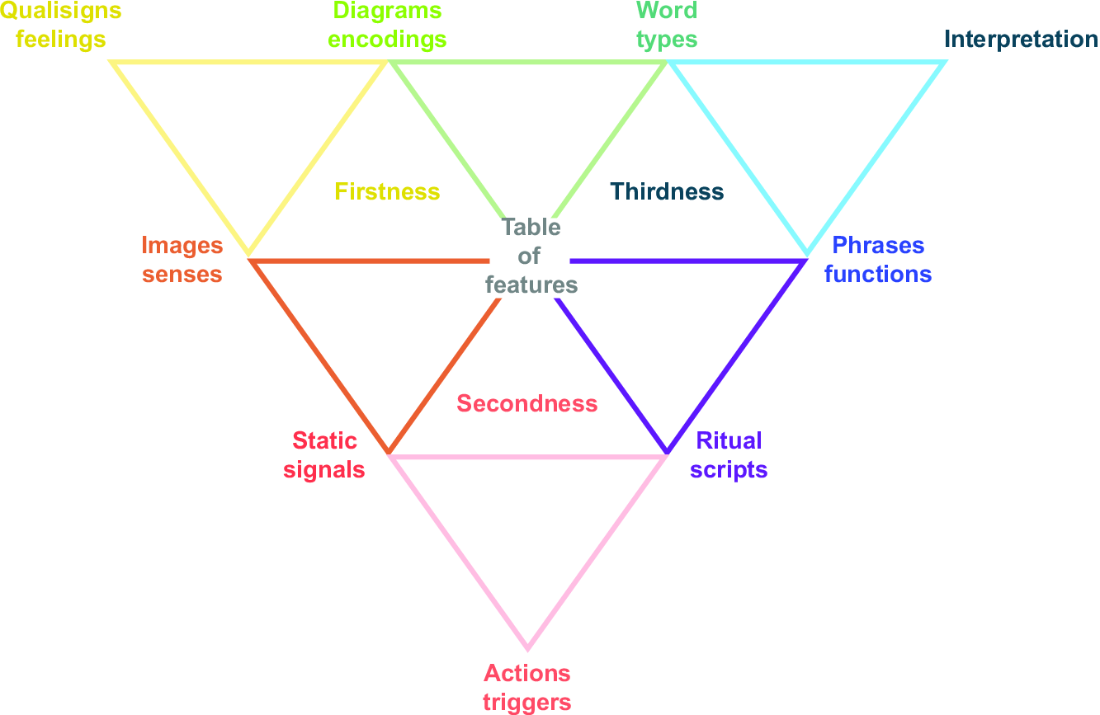
Use the recursive Peircean semiotic triangle to organize the minimal parts involved in extracting meaning from language. Firstness, secondness, and thirdness mark the sequence and orientation of interpretation rather than the triangle's individual points. section 2.1.2
The interpretation sequence connects:
- Feelings attached to images and encodings before interpretation reaches words and tables. section 2.1.2
- Rituals and common scripts with interpreted actions that become second nature. section 2.1.2
- Semiotic analysis with syntax, semantics, pragmatics, and language-modeling history. section 2.0
Reading the interpretation diagram
Figure 2.3 replaces descriptive labels with examples and asks readers to follow the arrows from the top-left corner, illustrating how interpretations are built and meaning extracted from interaction. section 2.1.2
