Sequence parallelism partitions neural-network activations along the sequence dimension, reducing redundant storage. It complements tensor parallelism by targeting memory-limiting normalization and dropout blocks that tensor parallelism does not efficiently distribute. section 3.3.2
Use the technique when activation memory, rather than computation, limits transformer efficiency:
- Combine it with tensor parallelism: tensor parallelism distributes computationally heavy MLP and attention layers, while sequence parallelism distributes memory-limiting work. section 3.3.2
- Expect experimentation: hardware and dataset dimensions determine the best partitioning strategy. section 3.3.2
Figure 3.5 Combining tensor parallelism that focuses on computational heavy layers with sequence parallelism to reduce memory overhead to create a fully parallel process for the entire transformer
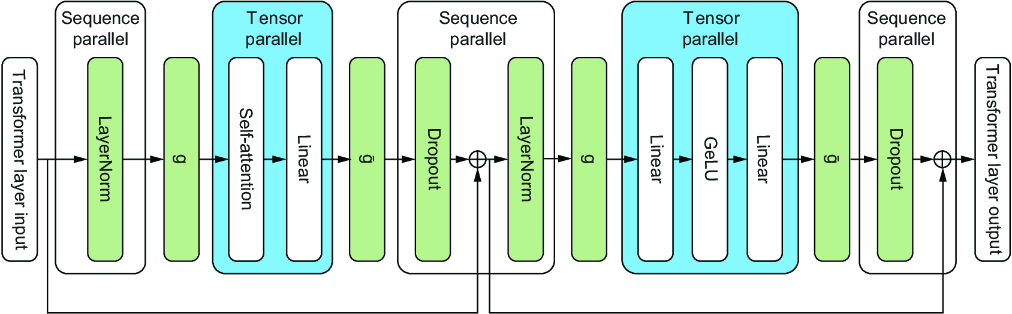
Use the diagram to see how tensor parallelism handles computation-heavy layers while sequence parallelism reduces activation-memory overhead across the transformer. section 3.3.2
