A sequence pattern is a temporal event pattern satisfied when instances of every listed event type occur in the specified order. Its matching set contains one event instance for each listed type. section 9.3.1
To test a sequence pattern:
- Treat the relevant event types list as ordered, and the participant event set as totally ordered. section 9.3.1
- Match every listed type in order; the matching instances need not be consecutive among participant events. section 9.3.1
Hospital readmission
The pattern <patient discharge, patient admission> is satisfied when a patient is discharged and then readmitted within 48 hours for the same reason. section 9.3.1
Figure 9.7. A sequence pattern example—a patient who is readmitted to the hospital within 48 hours of having been discharged
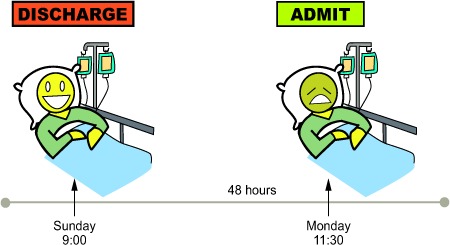
Use the diagram to see the discharge-then-readmission example. section 9.3.1