Sequential decision-making means choosing repeatedly as conditions change and outcomes remain uncertain. Each choice can shape the situation faced by later decisions, so good decisions account for both current information and available resources. section 1.0
Reinforcement learning is one approach: an agent acts, receives feedback, and adapts its strategy through experience. It is not a fit for every problem; limited data or feedback, or a need for simpler and more interpretable methods, may favor other tools. section 1.7
Figure 1.7 Overview of reinforcement learning framework.
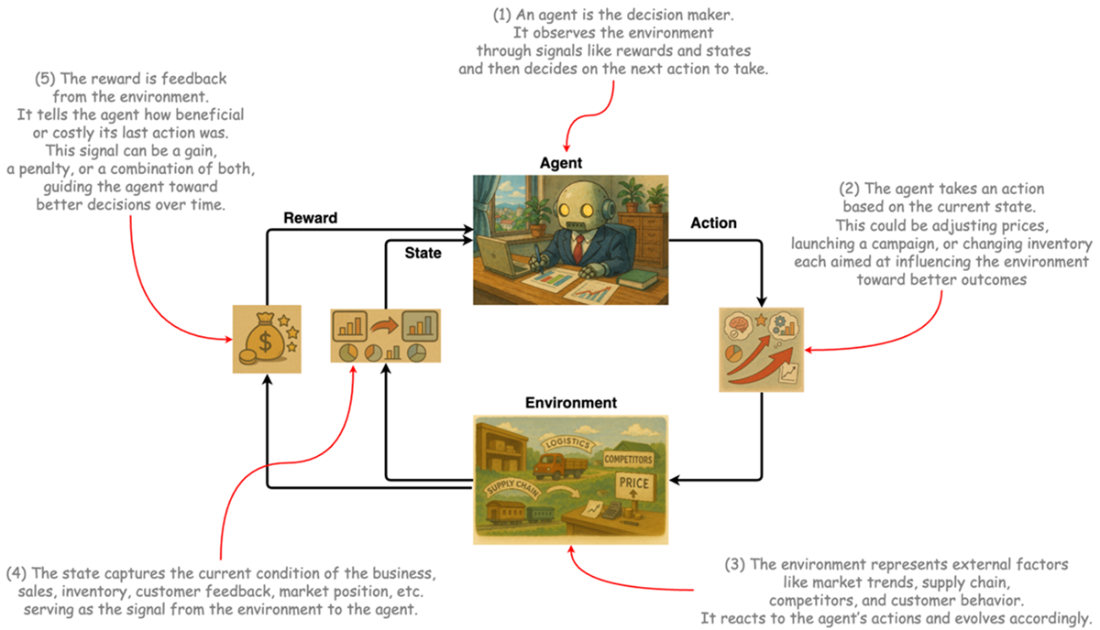
Use the framework overview to see how reinforcement learning supports sequential decisions. section 1.7
A Markov decision process provides a framework for formulating these problems. Solution methods differ in whether they use a model of transitions and rewards or learn from experience; dynamic programming applies when the transition model is known. section 4.0
Reinforcement learning can extend classical optimization with adaptive decisions in dynamic settings, but it brings training costs, data needs, and explainability challenges. section 1.9


