liveBook · Manning

Serde_json

As explained in Refactoring to Rust

serde_json is a Rust crate that converts between Serde's generic data model and JSON.

serde_json bridges Serde’s generic serialization model and the JSON data format. Use serde_json::from_str to deserialize a JSON string into a typed Rust structure. section 6.3 section 6.7

A minimal typed JSON parser requires:

  • Derive serde::Deserialize for the destination struct and Debug if it will be printed with {:?}. section 6.3

Parsing a JSON object

With #[derive(Debug, serde::Deserialize)] on Data, serde_json::from_str parses { "name": "Sharpe Oliver", "value": 134087 } into Data and prints its fields. A mismatched field type produces a deserialization error; calling unwrap then panics.

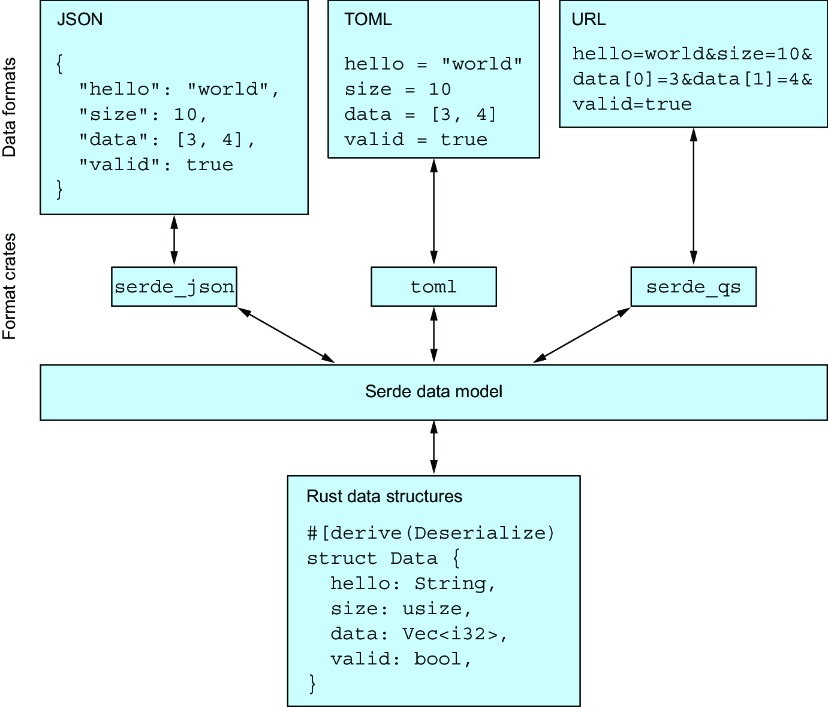
Figure 6.1 The Serde ecosystem
figure

The ecosystem diagram helps distinguish Serde’s format-independent data model from serde_json’s JSON-specific bridge. section 6.3


How Refactoring to Rust covers it

How deep it goes
Explains dependency setup, derive-based deserialization, type inference errors, and mismatched-type failures without covering advanced customization.
Examples
Uses typed name-and-value JSON objects, Cargo configuration, compiler diagnostics, and a Python-equivalent summation program.
What it assumes
Assumes basic Rust structs, Cargo projects, and JSON syntax while teaching Serde traits and derive setup incrementally.
What you can do after
Build typed JSON parsers from strings using serde_json::from_str and Serde derive attributes.
How it connects
Connects Serde, serialization, deserialization, Rust structs, Cargo, and dynamic-language integration.

Also explained in

Compare how 2 books explain serde_json →

Related concepts

This explainer was generated by Manning's knowledge graph from the text of Refactoring to Rust. The section links point to the parts of the book it draws on.