A sentiment analysis classifier uses patterns in text to predict a sentiment category, such as happy or sad. Word counts can turn a sentence into features for making that prediction. section 5.1
Predicting an alien’s mood
In a toy language with the words “aack” and “beep,” predict happy when aack appears more often, sad when beep appears more often, and happy on a tie. The rule can be pictured as a line dividing the word-count points into two regions. section 5.1
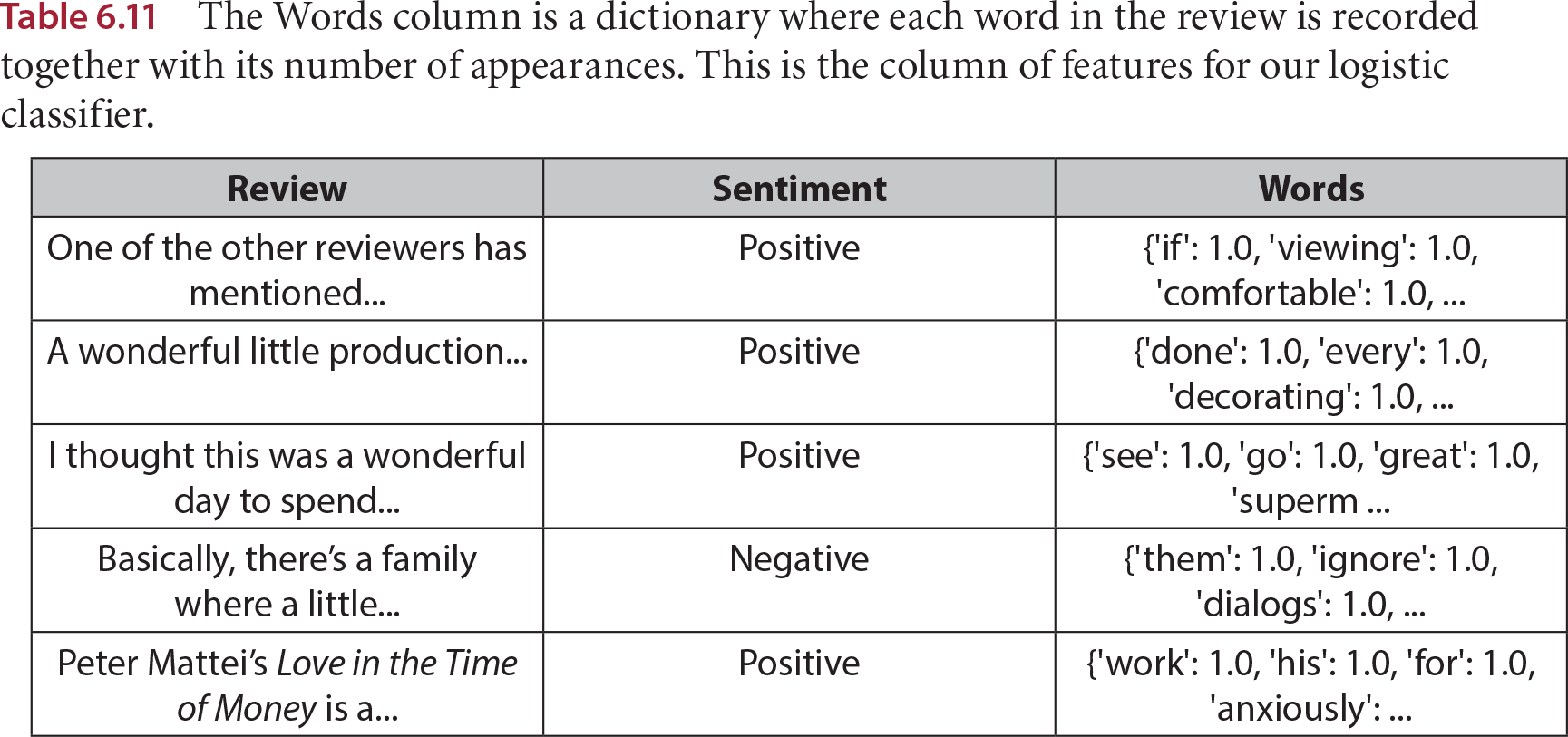
Table 6.11 The Words column is a dictionary where each word in the review is recorded together with its number of appearances. This is the column of features for our logistic classifier. (view table figure)
| Review |
Sentiment |
Words |
| One of the other reviewers has mentioned... |
Positive |
{'if': 1.0, 'viewing': 1.0, 'comfortable': 1.0, ... |
| A wonderful little production... |
Positive |
{'done': 1.0, 'every': 1.0, 'decorating': 1.0, ... |
| I thought this was a wonderful day to spend... |
Positive |
{'see': 1.0, 'go': 1.0, 'great': 1.0, 'superm ... |
| Basically, there’s a family where a little... |
Negative |
{'them': 1.0, 'ignore': 1.0, 'dialogs': 1.0, ... |
| Peter Mattei’s Love in the Time of Money is a... |
Positive |
{'work': 1.0, 'his': 1.0, 'for': 1.0, 'anxiously': ... |
The review rows pair positive or negative labels with word-count dictionaries, showing how raw text becomes features for classification. section 6.4
For IMDB reviews, Turi Create turns review text into word-count features and fits a logistic classifier to predict sentiment. Predictions can be sorted to find the most positive and negative reviews. Removing punctuation, capitalization, or stop words is suggested as a possible improvement. section 6.4