liveBook · Manning

Service instance

As explained in Microservices Patterns, Second Edition

A running deployment of a service that has a network location and can handle requests.

A service instance is a running deployment with a network location, such as an IP address and port. In cloud-based microservices, locations and the set of available instances change as services scale, fail, or upgrade, so clients cannot rely on hardcoded addresses. section 8.2.5

Service discovery locates available instances when a client invokes a service. A service registry tracks their network locations; the discovery mechanism updates it as instances start and stop, then uses it to find a destination for a request. section 8.2.5

Figure 8.10 The service registry keeps track of the service instances. Clients query the service registry to find network locations of available service instances.
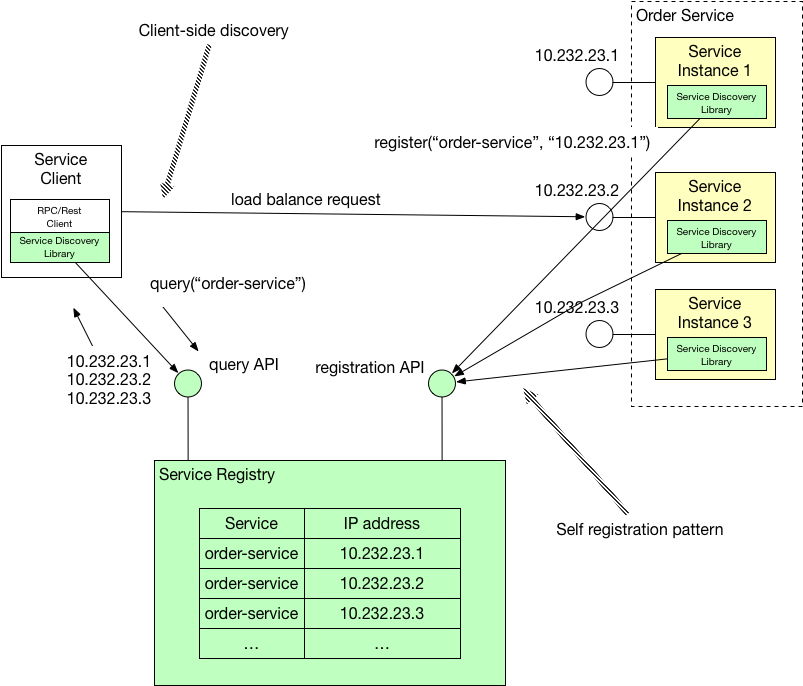
ApplicationLevelServiceDiscovery

The registry connects changing service instances with clients seeking an available network location. section 8.2.5

How Microservices Patterns, Second Edition covers it

How deep it goes
Defines dynamic instance locations and explains registry-based discovery, stopping before detailed application-level implementation.
Examples
Uses a client invoking a REST API and contrasts static physical-host locations with dynamic cloud deployments.
What you can do after
Apply service discovery to locate available instances instead of hardcoding network addresses.
How it connects
Connects service instances to service discovery, service registries, autoscaling, and request routing.

Related concepts

This explainer was generated by Manning's knowledge graph from the text of Microservices Patterns, Second Edition. The section links point to the parts of the book it draws on.