liveBook · Manning

Service-port interface

As explained in Acing the CCNA Exam: Volume 2 Advanced Networking and Security

A service-port interface is the logical interface corresponding to a wireless LAN controller's physical service port.

A service-port interface is the logical interface corresponding to a WLC’s physical service port. The service port provides dedicated out-of-band management separate from distribution-system connections. section 21.2.1

Operational facts:

  • The physical service port is a dedicated management connection for out-of-band WLC access. section 21.2.1
  • The service port does not support VLAN tagging, so it must connect to an access port on the switch. section 21.2.1
  • The service-port interface is distinct from physical WLC ports, just as other WLC interfaces are logical entities. section 21.2.1
Figure 21.9 WLC ports and interfaces. Ports are physical connectors that connect to other devices, and interfaces are logical entities in the WLC.
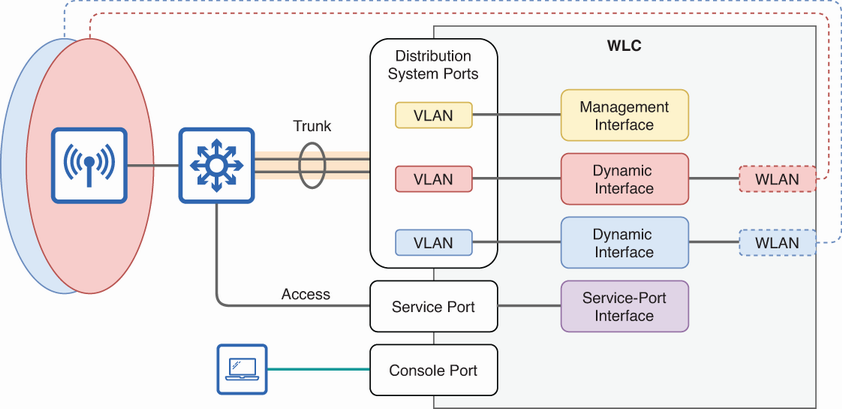
Use the figure to distinguish the physical service-port connector from its corresponding logical interface. section 21.2.1

How Acing the CCNA Exam: Volume 2 Advanced Networking and Security covers it

How deep it goes
Defines the logical-to-physical correspondence and access-port limitation, but provides no configuration procedure.
Examples
Illustrates the service-port interface in Figure 21.9 and notes its absence from the example network.
What it assumes
Distinguishes physical WLC ports from logical interfaces, using switch SVIs as a comparison for logical entities.
What you can do after
Operate out-of-band WLC management by identifying the service-port interface and using an untagged access-port connection.
How it connects
Links physical ports with logical interfaces, out-of-band management, VLAN tagging, and access-port switching.

This explainer was generated by Manning's knowledge graph from the text of Acing the CCNA Exam: Volume 2 Advanced Networking and Security. The section links point to the parts of the book it draws on.