Set intersection keeps only what two objects share. Geometrically, that shared part may be a point, a line, or a region. Two nonparallel lines in a plane meet at a point; two nonparallel planes in 3D meet along a line. The same idea turns a system of linear equations into a geometric search for the common place satisfying every equation. section 2.3.1 section 3.1.1
The result depends on the representation. For equations, intersection identifies common solutions. For a line joined to an arc, the intersection point helps position the pieces, while an orthogonality condition makes the join smooth. For solid-like models, intersection retains the area or volume that belongs to both inputs. section 3.1.1 section 5.3.2 section 10.2.2
Common ways to express an intersection include:
- Solve several line, plane, or hyperplane equations together. Their shared solution is the intersection; in a two-variable system it is a point, and in a three-variable system it is where all planes meet. section 3.1.1
- Combine signed distance functions with maximum. A point remains inside the result only when both input functions are negative. section 10.2.2
- Apply a Boolean operation to voxel models or image masks. Only pixels or voxels filled in both models remain. section 12.3.4
Intersecting two circle SDFs
For two circle functions Z1 and Z2, compute Z = maximum(Z1, Z2). Negative values mark points inside both circles, so the negative region is their overlap. This is a concise constructive-solid-geometry operation, but the combined function is not necessarily a true distance function: it can still model the shape while no longer reporting the true distance to it. section 10.2.2
Figure 10.13 An intersection of two SDFs is negative when both SDFs are negative and positive otherwise.
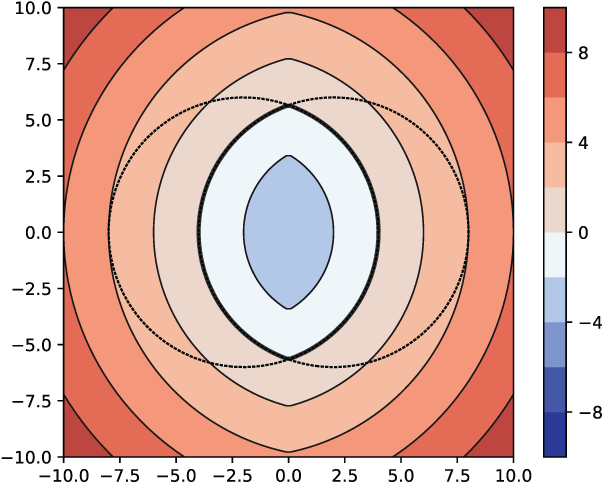
The plotted overlap makes the sign rule visible: only the region inside both circles remains negative. section 10.2.2
Intersection is especially practical when a representation makes membership cheap to test. Voxel and mask operations work like element-by-element Boolean values and are described as simple and usually faultproof, unlike Boolean operations on boundary representations. That robustness supports multistep modeling workflows. SDF composition is also compact, though algorithms needing true distances require care after combinations. section 10.2.2 section 12.3.4




