SHA-3 is a standardized family of cryptographic hash algorithms built from Keccak’s sponge construction. It was selected after NIST’s competition, initiated in response to concerns about SHA-1 and SHA-2. section 6.3.2 section 6.3
A sponge processes input in two phases. During absorption, message blocks are XORed into only the rate portion of an internal state before permutation. During squeezing, output is read from that portion while the state is repeatedly permuted, allowing arbitrary-length output. section 6.3.2
The rate–capacity split determines how the construction handles data and resists collisions:
- Rate (r) identifies the state portion written during absorption and read during squeezing. section 6.3.2
- Capacity (c) remains untouched by external input and output while still being mixed by the permutation; it determines collision resistance. section 6.3.2
- For fixed-length SHA-3 variants, collision resistance is the smaller of half the output size and half the capacity. section 6.3.2
Figure 6.6 Sponge construction has an absorption phase and a squeezing phase.
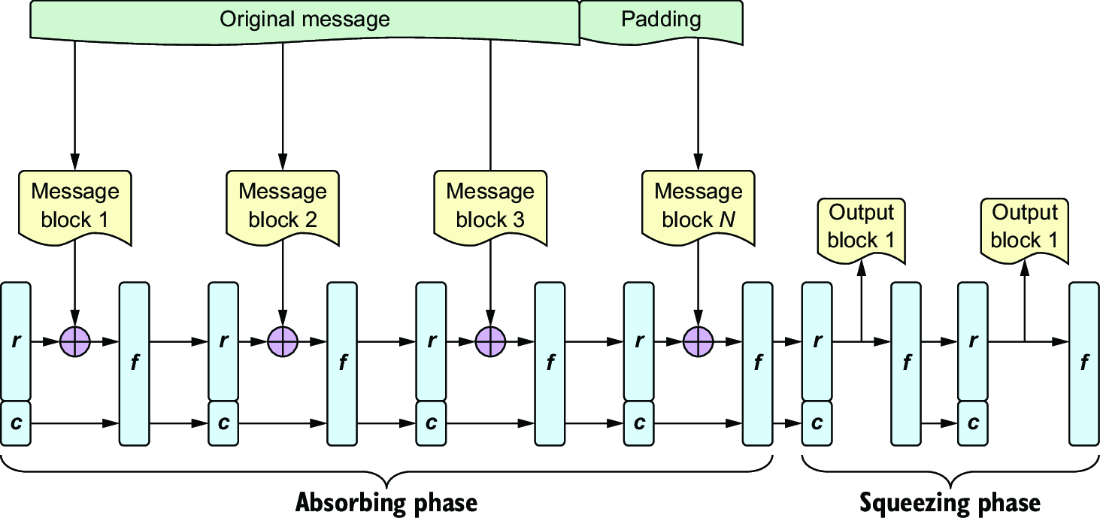
Use the sponge diagram to trace absorption, permutation, squeezing, and the separation between rate and capacity. section 6.3.2
Table 6.2 SHA-3 family of sponge-based hash functions
| Hash function | Output size \(d\) (bits) | Rate \(r\) (bits) | Capacity \(c\) (bits) | Collision resistance (bits) |
| SHA3-224 | 224 | 1152 | 448 | \(\frac{d}{2} = 112\) |
| SHA3-256 | 256 | 1088 | 512 | \(\frac{d}{2} = 128\) |
| SHA3-384 | 384 | 832 | 768 | \(\frac{d}{2} = 192\) |
| SHA3-512 | 512 | 576 | 1,024 | \(\frac{d}{2} = 256\) |
| SHAKE128 | \(d\) | 1,344 | 256 | \(min(\frac{d}{2}, \frac{c}{2}) = min(\frac{d}{2}, 128)\) |
| SHAKE256 | \(d\) | 1,088 | 512 | \(min(\frac{d}{2}, \frac{c}{2}) = min(\frac{d}{2}, 256)\) |
Compare SHA3-224, SHA3-256, SHA3-384, SHA3-512, SHAKE128, and SHAKE256 by output size, rate, capacity, and collision resistance. section 6.3.2
The sponge design contrasts with Merkle–Damgård hashing. SHA-1 and SHA-2 use the older construction and are susceptible to length-extension attacks; sponge-based SHA-3 avoids that weakness. section 7.3 section 6.3


