Shallow NLP uses relatively few processing stages and limited linguistic representation depth. It can still support useful language applications without extensive human labeling or text curation. section 1.9
Pattern matching illustrates the approach: regular expressions can find approximate grammar matches, while fuzzy regular expressions tolerate bounded insertion, deletion, and substitution errors. These systems remain practical but become difficult to expand as behaviors and grammar rules grow. section 1.9 section 1.9
Shallow NLP is especially useful when:
- A system needs lightweight pattern-based language behavior. section 1.9
- Learning can continue from an environmental stream such as Twitter, with little or no labeling. section 1.9
- Reliability depends on constrained patterns rather than broad, deeply represented language understanding. section 1.9
Figure 1.8 Example layers for an NLP pipeline
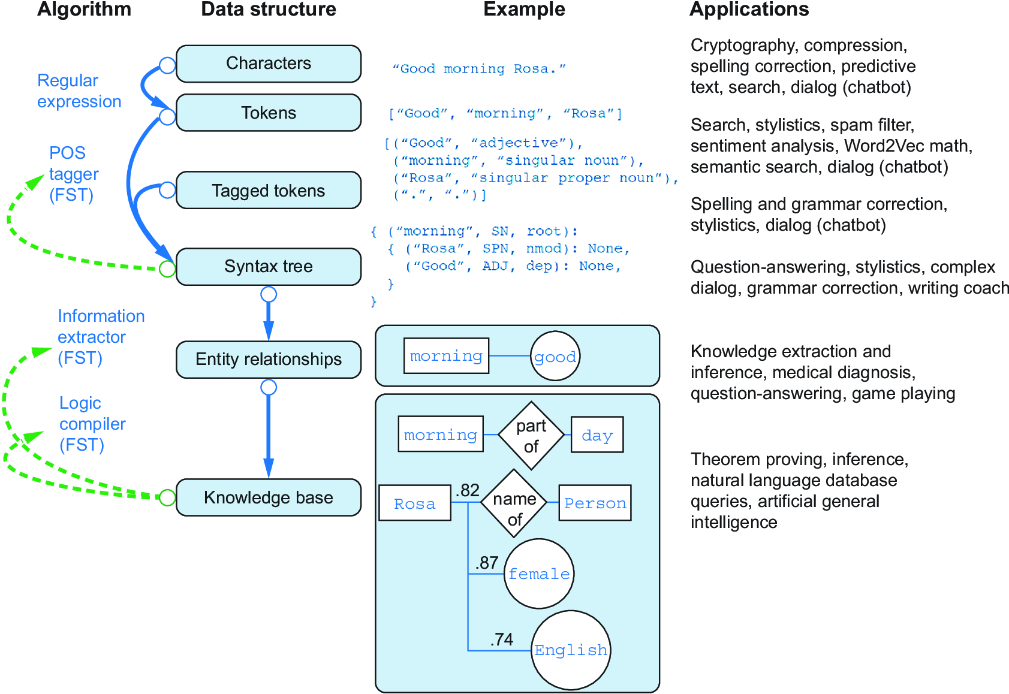
Use the pipeline-layer figure to place shallow processing within a broader NLP pipeline and compare its limited depth with additional processing stages. section 1.9
