A shape parameter changes the form of a probability distribution rather than simply moving it or uniformly widening or narrowing it. section 2.1.7
Distinguish the main parameter roles:
- Location parameters shift a distribution to characterize where it is centered. section 2.1.7
- Scale parameters control the distribution’s spread. section 2.1.7
- Shape parameters alter how probability is arranged, including asymmetry or skewness, without being reducible to shifting or scaling. section 2.1.7
Distribution modeling in Pyro
Pyro exposes canonical distributions as modeling primitives with parameters such as location, scale, concentration, and rate. A Gamma distribution can therefore be instantiated with concentration=1.0 and rate=2.0, illustrating how parameterized distribution families become reusable model components. section 2.1.7
Figure 2.10 A popular common set of canonical probability distributions. The edges capture mathematical relationships between the distributions (that we won’t get into here). Light-colored distributions are discrete and dark-colored distributions are continuous. An arrow represents the existence of a transformation that converts one distribution to another.
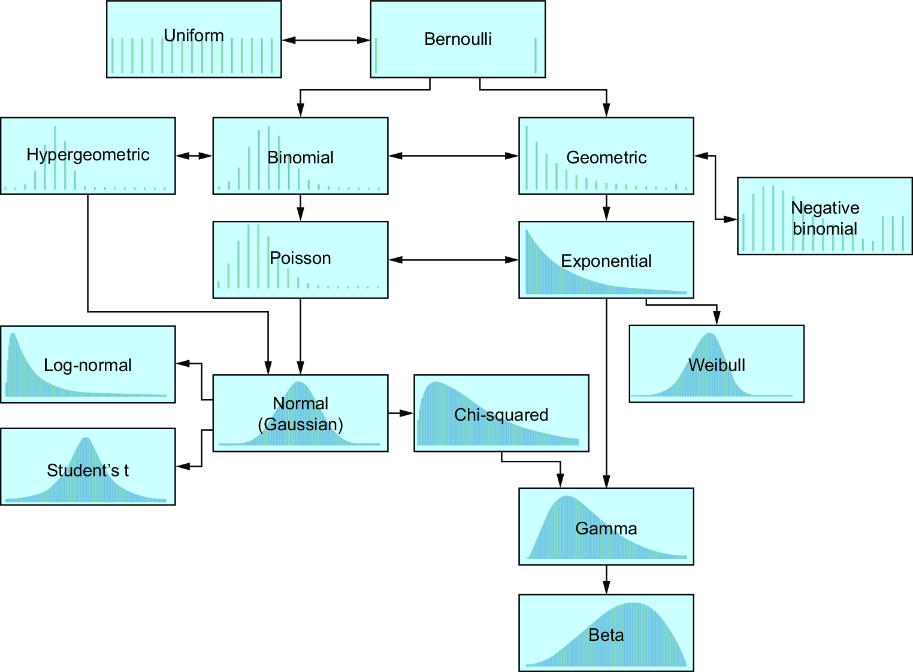
A distribution map helps situate shape-related parameters among canonical probability distributions and their mathematical relationships. section 2.1.7
