Shard sizing chooses how many primary shards an index needs and how much data each shard should hold. Start with expected data volume, including future growth, then check the heap memory and disk capacity available on the nodes that will host primaries and replicas. There is no universal shard count: validate a proposed design with sizing trials before treating it as a production configuration. section 3.2.4 section 14.3
A practical starting guideline is 25–40 GB per shard, while an often cited upper bound is 50 GB. Larger shards can exist, but their suitability depends on the workload and resources. Plan for roughly up to 20 shards per gigabyte of heap memory, and adjust JVM heap settings when the available machine memory permits it. section 3.2.4
Sizing a 500 GB movie index
If a movie index may grow to 500 GB, distribute its data across about 10–20 primary shards on multiple nodes. That puts the primary-shard target near the suggested range rather than placing the whole index on a few very large shards. Then add replicas for availability and read capacity, remembering that every replica is a full copy of its primary shard. section 3.2.4 section 14.0
Count replica storage as part of the cluster requirement, not as a minor overhead. For example, 10 primary shards sized at 50 GB require 500 GB; with two replicas per primary, 20 replica copies add 1,000 GB, for at least 1.5 TB before operational headroom. Reserve additional capacity for system indexes, in-memory structures, and other node operations. section 14.3.1
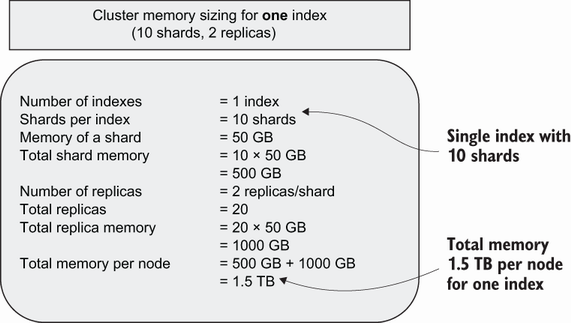
Use the capacity diagram to trace how 10 primary shards and two replicas per shard turn a 500 GB primary data set into a larger multi-node storage requirement. section 14.3.1
Size shards as part of cluster administration. More nodes let Elasticsearch spread shards across the cluster, while replicas can help relieve read-performance pressure. Revisit the plan as data volume, node resources, and availability needs change; initial sizing work avoids preventable operational problems later. section 3.2.4 section 14.0
