A side channel is an unintended information pathway: software or hardware reveals secret-dependent data indirectly, allowing attackers to reconstruct a key. section 13.4
Common leakage pathways include:
- Timing attacks measure response differences; comparing MAC authentication tags non-constant-time can reveal the correct tag remotely. section 13.4
- Power analysis measures electricity consumed during cryptographic operations. Differential power analysis can extract keys from variations across encryptions. section 13.4
- Other physical channels include electromagnetic radiation, vibration, and sound emitted by hardware. section 13.4
A power trace reveals an RSA key
An RSA square-and-multiply routine performs a square for every private-exponent bit and a multiply only when that bit is set. Because multiplication consumes more power, one trace can expose the private key when mitigations are absent. section 13.4
Figure 13.5 Some cryptographic algorithms leak so much information via their power consumption that a simple power analysis of a single power trace (a measure of the power consumed in time) can leak the private key of the algorithm. For example, this figure represents a trace of an RSA exponentiation (the message being exponentiated to the private exponent; see chapter 6). The RSA exponentiation is implemented with a square-and-multiply algorithm that iterates through the bits of the private exponent; for each bit it applies a square operation followed by a multiply operation only if the bit is set. In this example, multiplication is obviously consuming more power; hence, the clarity of the power trace.
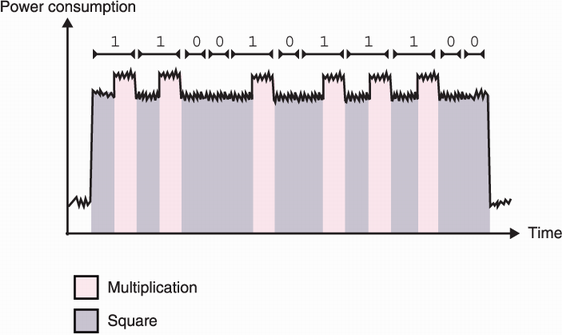
Use the power trace to see how operation-dependent consumption maps onto bits of an RSA private exponent. section 13.4
