A cryptographic device can reveal a secret without printing it. An attacker may measure timing, power use, electromagnetic radiation, vibrations, sound, returned errors, or memory-access delays, then infer secret-dependent information. section 13.0 section 13.4
One power trace, one private key
In RSA square-and-multiply exponentiation, each private-exponent bit triggers a square and, when set, a multiply. If multiplication consumes more power, a single power trace can expose the private key through simple power analysis. section 13.4
Figure 13.5 Some cryptographic algorithms leak so much information via their power consumption that a simple power analysis of a single power trace (a measure of the power consumed in time) can leak the private key of the algorithm. For example, this figure represents a trace of an RSA exponentiation (the message being exponentiated to the private exponent; see chapter 6). The RSA exponentiation is implemented with a square-and-multiply algorithm that iterates through the bits of the private exponent; for each bit it applies a square operation followed by a multiply operation only if the bit is set. In this example, multiplication is obviously consuming more power; hence, the clarity of the power trace.
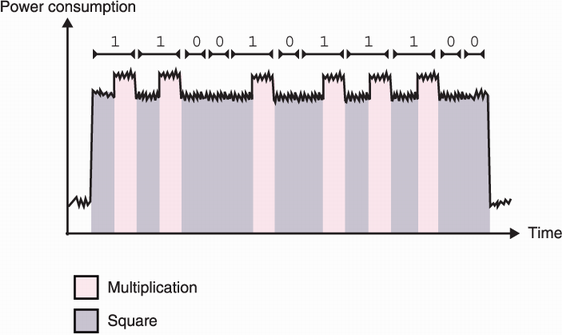
Use the power trace to connect algorithmic branches with observable physical leakage: visibly stronger multiplication activity reveals private-exponent bits. section 13.4
Reduce leakage and limit what a successful attack can expose:
- Use constant-time algorithms; avoid branches and memory accesses controlled by secret data. section 13.5
- Apply blinding and masking to decorrelate sensitive operations from secrets or known input data. section 13.5
- Return indistinguishable errors and avoid early exits, especially during RSA PKCS#1 v1.5 padding validation in TLS. section 13.4
- Combine software and hardware defenses, use unique keys per device or operation, and accept residual risk explicitly. section 13.5


