The sign function reports whether a numeric expression is negative, zero, or positive. In binary classification, applying sign to a decision-boundary function reveals which side of the boundary contains an input point. section 3.1.4
For a boundary defined by φ(x, b) = 0, interpret its sign as follows:
- φ(x, b) < 0 places the point on one side of the decision boundary. section 3.1.4
- φ(x, b) = 0 places the point on the boundary itself. section 7.2.2
- φ(x, b) > 0 places the point on the opposite side. section 3.1.4
A two-dimensional separator
The line y + 2x + 1 = 0 divides the plane into two half-planes. Evaluating y₀ + 2x₀ + 1 for a point (x₀, y₀) determines its side: a negative result identifies one half-plane, a positive result the other, and zero means the point lies on the line. section 3.1.4
Figure 3.3 Given a point (x0, y0) and a separator y + 2x + 1 = 0, we can tell which side of the separator the point lies on from the sign of y0 + 2x0 + 1.
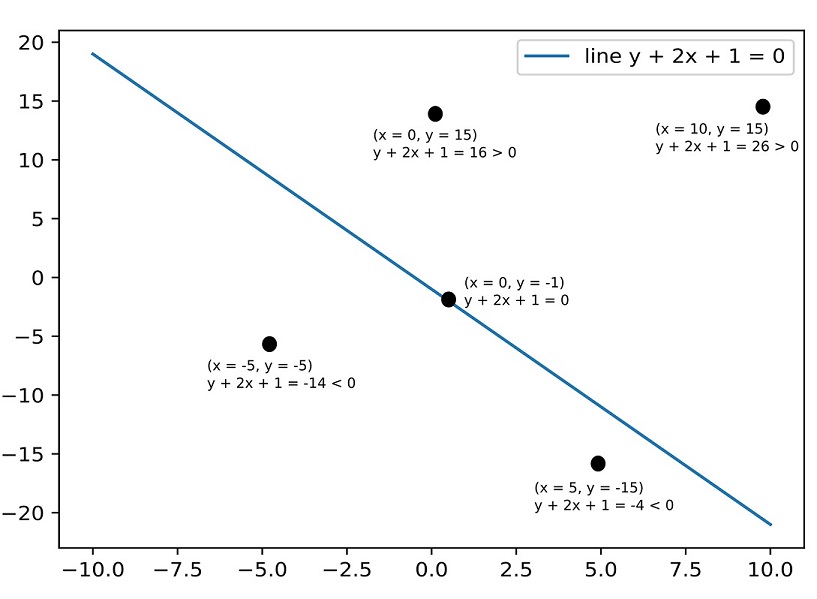
Use the separator diagram to connect the sign of the surface function with the geometric side of a decision boundary. section 3.1.4

