liveBook · Manning

Signal generation

As explained in Applied Reinforcement Learning

The process of turning raw information into numeric views about the likely direction or behavior of assets.

In systematic investing, signal generation turns raw information into numeric views about which assets may rise or fall. It is the first stage of a pipeline: portfolio construction uses signals to choose holdings, and execution works those orders into the market. section 12.3

From news to a portfolio signal

A language model reads news and converts it into a structured numeric market view. An RL agent combines that signal with price features to choose portfolio holdings. section 12.3

Figure 12.3 The capstone system: news to signal to state to allocation.
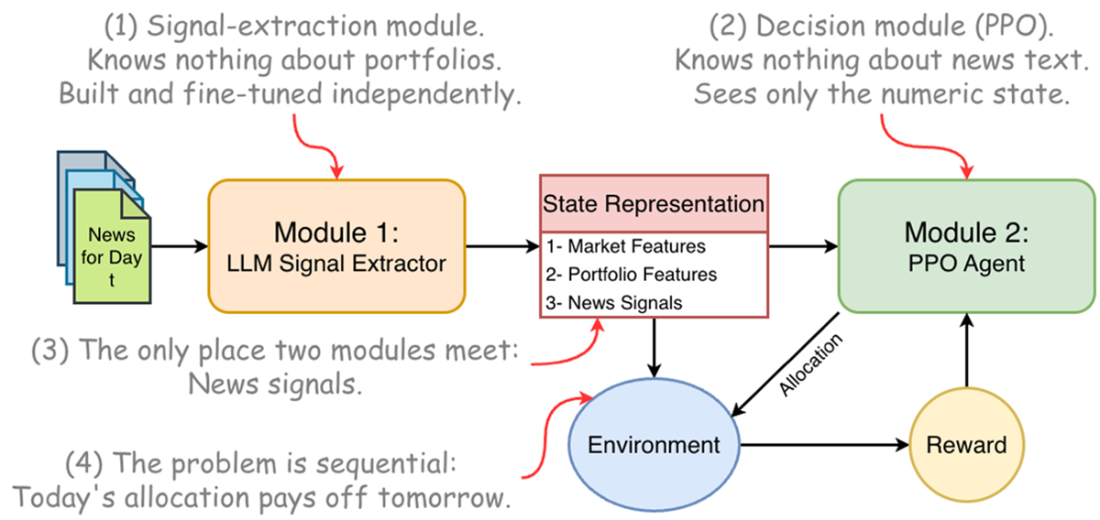
Trace the system’s flow from news through signal and state to portfolio allocation. section 12.3

How Applied Reinforcement Learning covers it

How deep it goes
Defines the signal’s role and illustrates an LLM news example, without detailing the model’s signal-generation mechanics.
Examples
Uses prices, company fundamentals, alternative data, and news as inputs, with an LLM converting news into a numeric view.
What you can do after
Understand how news can become a structured numeric market view that informs portfolio allocation.
How it connects
Connects signal generation to portfolio construction and execution as distinct stages of systematic trading.

Related concepts

This explainer was generated by Manning's knowledge graph from the text of Applied Reinforcement Learning. The section links point to the parts of the book it draws on.