Signal-to-noise ratio (SNR) asks whether data carries genuine, repeatable predictive power or whether apparent patterns are spurious. Low SNR means random market noise can drown out a potential signal. section 10.2.1
Use SNR as one part of financial data due diligence:
- Assess whether the data offers genuine predictive value, alongside reliability, timeliness, capacity, and cost-effectiveness. section 10.2.1
- For low-SNR financial data, random forests use bagging to average predictions from decorrelated trees, reducing noise and improving stability. section 10.5.2
Figure 10.2 The professional quant’s framework for evaluating data sources is a five-point due diligence process to systematically filter potential alpha streams. In a world of infinite data, the ability to make intelligent choices is paramount. This framework isn’t merely a checklist but a rigorous gating process that professional funds use to assess the viability of any potential data source before committing significant time and resources.
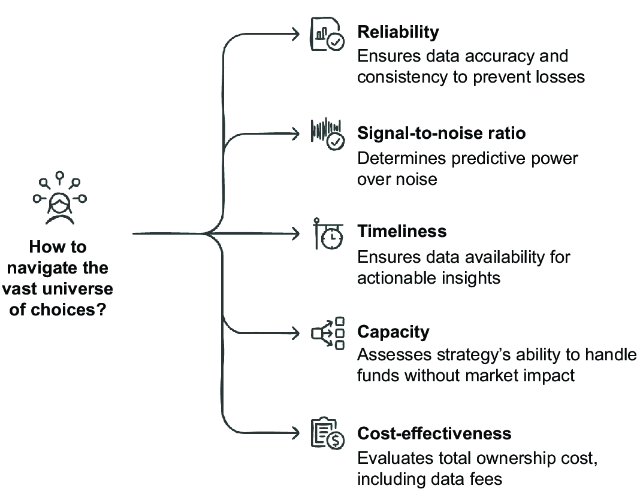
The five-point data-source framework places SNR alongside four other criteria for screening potential alpha streams. section 10.2.1
