A single broad prompt handles multiple classification categories and decision boundaries in one step. It favors simplicity, quick implementation, and lower management overhead when accuracy remains acceptable. section 14.5.2
Design and evaluate the prompt around:
- Clear instructions, defined categories, boundary cases, representative examples, and an explicit output format. section 14.5.2
- A concrete intent-detection scheme such as Data-Related, System-Related, and Feedback/Complaints, with System-Related optionally divided into Documentation-Related and Schema-Related. section 14.5.2
- Reasons for each prediction, which can expose missing context and guide improvements to the task definition. section 14.5.2
- A later transition to multistage classification when requests, edge cases, or category changes demand finer control. section 14.5.2
Figure 14.6 Classification of system-related questions in the intent detection system, showing how requests are routed either to documentation (for system functionality and feature questions) or to the schema (for KG structure queries). The system also identifies feedback and issues as a separate category for user complaints or enhancement requests.
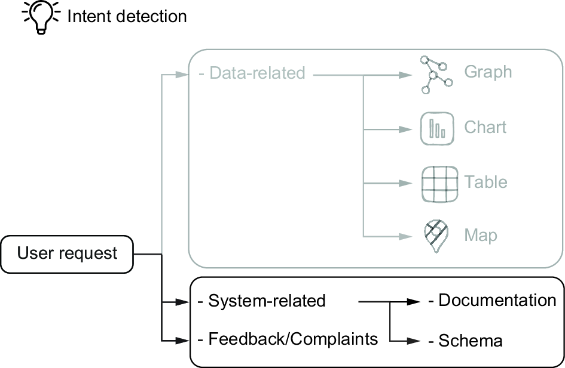
Use the routing diagram to connect broad intent categories with documentation, knowledge-graph schema, or feedback handling. section 14.5.2
