liveBook · Manning

Single-modal model

As explained in Build a Text-to-Image Generator (from Scratch)

A unimodal model processes data within a single modality, such as text-only or image-only data.

A single-modal model, or unimodal model, processes data within one modality, such as text-only or image-only data. Its input and output remain within the same data type, unlike a multimodal model that connects text, images, audio, or video. section 1.1.1

Typical single-modal patterns include:

  • A text model receives text and generates text; GPT-3 is given as an example. section 1.1.1
  • An image model can generate images from random noise while processing only image data. section 1.1.1
  • A text-to-image system is multimodal because it accepts text and produces an image rather than staying within one modality. section 1.1.1
Figure 1.1 Comparison of unimodal and multimodal models
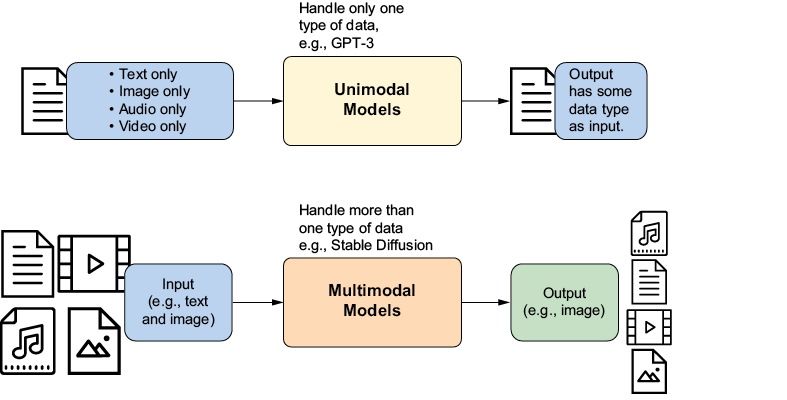
Use the comparison figure to distinguish same-modality input/output from cross-modality interaction. section 1.1.1


How Build a Text-to-Image Generator (from Scratch) covers it

How deep it goes
Defines same-modality processing and contrasts it with multimodal processing, stopping short of detailed architecture or implementation.
Examples
Uses GPT-3 for text-to-text processing and image generation from random noise as unimodal examples.
What you can do after
Evaluate whether a model is unimodal by checking whether its inputs and outputs remain within one data modality.
How it connects
Connects unimodal models with generative AI, language models, multimodal models, transformers, and diffusion models.

Also explained in

Compare how 2 books explain single-modal model →

Related concepts

This explainer was generated by Manning's knowledge graph from the text of Build a Text-to-Image Generator (from Scratch). The section links point to the parts of the book it draws on.