Causal questions often ask what would have happened if a recommendation policy had been different. The single-world assumption permits reasoning about that intervention while also knowing the policy’s natural, unintervened value. It assumes the intervention occurs before the natural value is realized and does not alter the system in a way that would change that value. section 10.7.5
In a single-world intervention graph (SWIG), node-splitting separates an intervention target into a constant representing the imposed value and a random variable retaining its natural causal role. This makes it possible to condition on the natural value T = +t while intervening with do(T = −t) in one graph. The trade-off is narrower counterfactual coverage: SWIGs support queries that can be connected to experimental validation, while counterfactual graphs can express queries requiring multiple worlds. section 10.10 section 10.7.5
Changing a recommendation policy
Suppose a subscriber with profile C = c would naturally receive policy +t for “Top picks for you.” An analyst forces the policy to −t before it takes effect. The assumption says the analyst can still know that +t was the natural value and that forcing −t did not fundamentally change the system that would otherwise have produced +t. section 10.7.5
Figure 11.13 The node-splitting transform splits the intervention target into a constant that keeps the children and a random variable that keeps the parents.
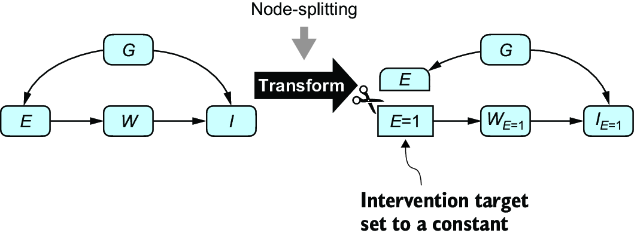
Use the node-splitting diagram to distinguish the imposed intervention value from the random variable preserving the target’s natural value. section 11.6.1
The assumption is operational in causal workflows rather than merely philosophical. Node-splitting enables level 3 queries whose factual conditions and hypothetical outcomes do not overlap, but those inferences remain dependent on the assumption and the model’s other identification conditions. Pyro implements node-splitting; PyMC’s do operation performs ordinary intervention, and behaves similarly when level 3 queries are not targeted. section 10.10 section 11.6.1
