Site reliability engineering (SRE) applies software engineering practices to operations and the complete service lifecycle, balancing innovation with dependable delivery. section 10.4.1 section 1.4
SRE organizes reliability work around three operational controls:
- Service level objectives (SLOs) define target performance and availability based on user expectations. section 10.4.1 section 10.4.2
- Service level indicators (SLIs) measure compliance through metrics such as latency, throughput, and error rates. section 10.4.1
- Error budgets define acceptable risk and help teams trade change velocity against system stability. section 10.4.1 section 10.4.3
SRE works as a temporary, embedded improvement capability rather than an operational silo. Engineers join mature product or platform teams, improve their lifecycle code and workflows, and transfer those lessons across teams. section 1.4.3
Reliability for payment processing
A team can define SLOs and SLIs for payment processing, monitor them with Prometheus and Grafana, and automate remediation for common failures. Automated recovery, rollbacks, and self-healing reduce manual intervention, downtime, and recovery time. section 10.4.2 section 10.4.4
Figure 1.6 There is a direct connection between each of these enablers and the resulting quality and effect of a platform.
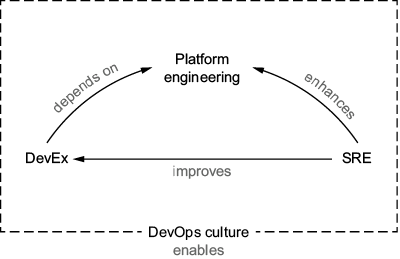
Use the platform-enablement diagram to relate SRE and other enabling practices to platform quality and organizational effect. section 1.4
