A small-molecule compound is a relatively low-molecular-weight chemical that can act as a drug or modulate a biological target. In RNA-targeted drug discovery, binding can inhibit RNA–protein interactions, alter splicing, or promote RNA degradation. Cancer-related RNA structures provide one therapeutic application. section 6.0
Small-molecule discovery against RNA combines chemical representation with predictive modeling:
- RNA offers fewer obvious binding pockets than many protein targets and changes among conformations, making binding sites and complexes difficult to characterize. section 6.0
- Selectivity is difficult because RNA uses four chemically similar nucleotides and contains repeated motifs across the transcriptome. section 6.0
- A QSAR workflow calculates molecular descriptors across protomer and conformer spaces, selects representative data with Kennard–Stone splitting, reduces dimensions with PCA, and improves models through sequential ensembles. section 6.5
RNA-targeted anticancer discovery
A small molecule designed to bind an RNA structure involved in cancer progression may be evaluated with a QSAR model that relates calculated chemical properties to binding performance. section 6.0 section 6.5
Figure 6.1 The general structure of our QSAR pipeline and major concepts we’ll cover along the way.
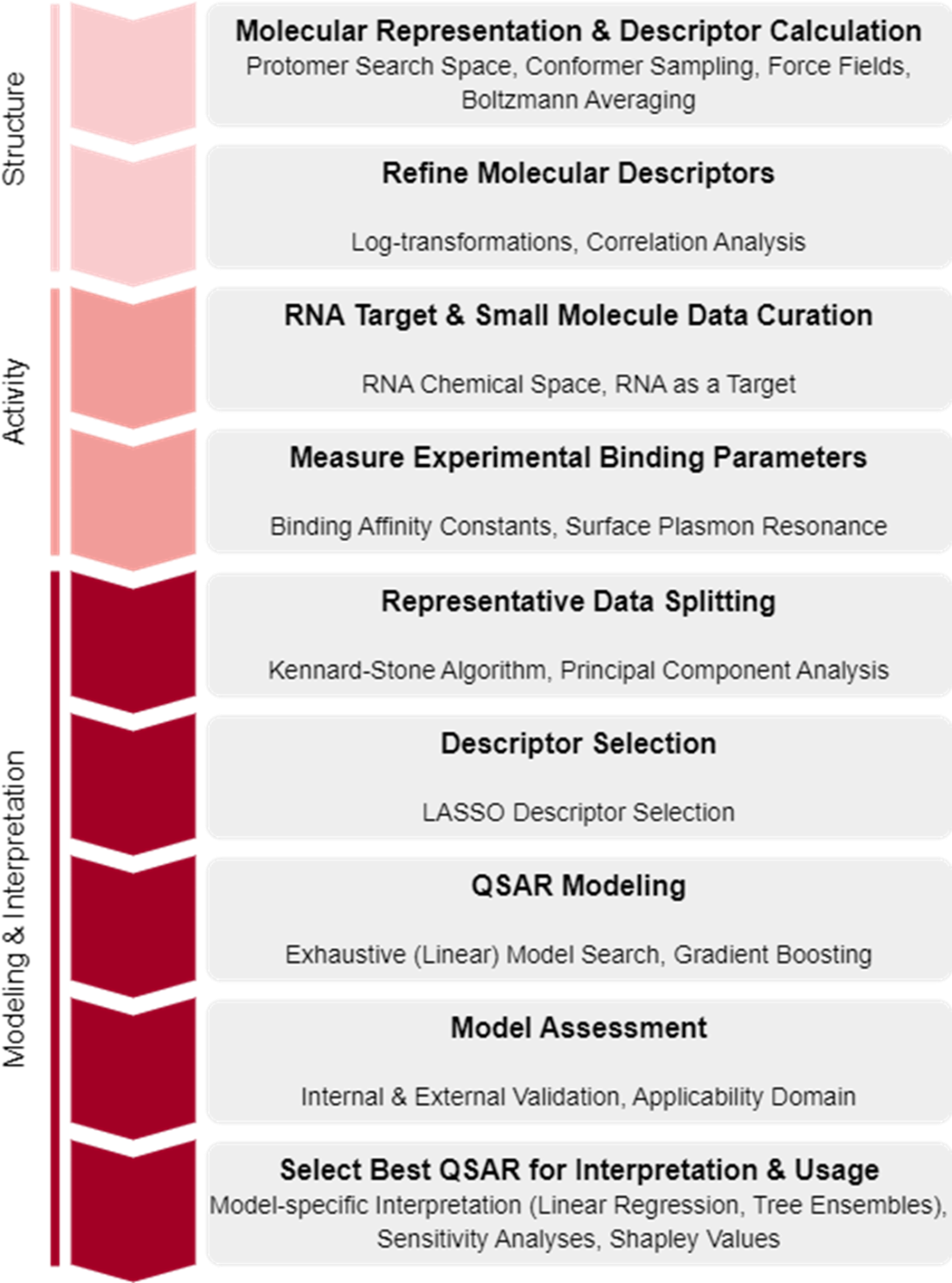
Use the pipeline overview to connect molecular representations, descriptor calculation, representative splitting, dimensionality reduction, ensemble learning, and interpretability. section 6.0
