liveBook · Manning

Smooth shading

As explained in Geometry for Programmers

Smooth shading is a rendering technique that interpolates surface normals or related attributes across polygonal faces to produce gradual visual variation.

A faceted sphere can look angular because each quad has its own normal. Smooth shading averages normals at model points and interpolates them across faces, producing gradual lighting changes without adding geometry. section 9.2.3

A convincing low-poly sphere

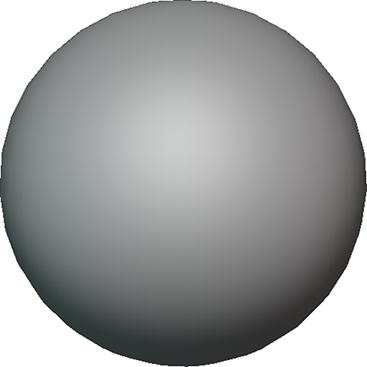
A sphere made from only a few hundred quads can appear smoothly curved onscreen. The mesh remains faceted; only the normals used for the lighting calculation change. This makes smooth shading an economical way to improve appearance. section 9.2.3

Figure 9.11 By smoothly interpolating the normals of a sphere made of quads, you make the sphere itself look smooth.
09-11

See how interpolated normals make a quad-based sphere look smooth while leaving its underlying geometry unchanged. section 9.2.3

Keep these distinctions in mind:

  • Smooth shading changes shading normals, not the model’s actual vertices, faces, or silhouette. section 9.2.3
  • Normal mapping goes further by altering normals from bitmap data, adding apparent detail without adding quads or triangles. section 9.2.3

How Geometry for Programmers covers it

How deep it goes
Explains averaged normals and interpolation, while deferring detailed comparisons among shading models.
Examples
Uses a sphere assembled from flat quadrilaterals and contrasts smooth shading with bitmap-based normal mapping.
What it assumes
Assumes surface normals, dot products, lighting directions, and interpolation as familiar geometric ideas.
What you can do after
Evaluate when interpolated normals can improve visual detail without adding geometry.
How it connects
Connects surface normals, dot-product lighting, polygonal meshes, color interpolation, and normal mapping.

Related concepts

This explainer was generated by Manning's knowledge graph from the text of Geometry for Programmers. The section links point to the parts of the book it draws on.