The smoothness assumption holds that records near each other in the input space tend to belong to the same class. It supports classification by making nearby points useful for assigning labels. section 15.3.2
Outlier detection often violates this assumption. Outliers may appear throughout the data space rather than forming one recognizable region, so a classifier trained on known outliers may place decision boundaries arbitrarily. This makes a general classifier for normal versus abnormal records unreliable, especially in higher dimensions. section 15.3.2
Known outliers among three clusters
A dataset contains three large inlier clusters and eight known outliers scattered elsewhere. A classifier can separate the observed points, but future outliers may occur almost anywhere outside the clusters, leaving no clear boundary. Classification becomes more feasible when many examples represent only a few specific outlier types. section 15.3.2
Figure 15.8 Left pane: dataset with known outliers. Inliers are drawn as dots and outliers as stars. Conceivably, we can create a classifier to separate these, but as the outliers are distributed throughout the space, it is not clear where to draw the decision boundary. This is much more of a problem in higher dimensions. Right pane: where there are many examples each of a small number of specific outliers, it is more feasible to classify these.
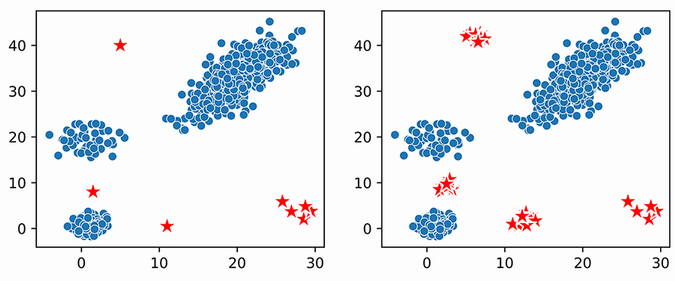
Compare scattered outliers, where the smoothness assumption gives little guidance, with repeated specific outlier types that form classifiable regions. section 15.3.2
