A Sobol sequence is an infinite list of points designed to cover a multidimensional Euclidean region evenly. It provides a practical candidate set when dense grids become intractable and ordinary uniform sampling leaves coverage gaps. section 5.3.2
Use Sobol points to support approximate optimization over a search space:
- Generate candidates in the unit cube with a Sobol engine. section 5.3.2
- Scale the candidates to the targeted search bounds. section 5.5
- Evaluate a Gaussian-process sample on the candidates and select the point with the highest sampled value for Thompson sampling. section 5.3.2
- Request multiple selected points for batch optimization by setting the sample count to the batch size. section 7.3
One-dimensional candidate generation
In PyTorch, create 1,000 scrambled Sobol candidates with `torch.quasirandom.SobolEngine(1, scramble=True)` and `sobol.draw(1000)`. For a search interval from −5 to 5, transform the unit-cube output with `10 * candidate_x − 5` before applying Thompson sampling. section 5.3.2
Figure 5.14 Points from a Sobol sequence vs. uniformly sampled points in the two-dimensional unit square. The Sobol sequence covers the square more evenly and, therefore, should be used by TS.
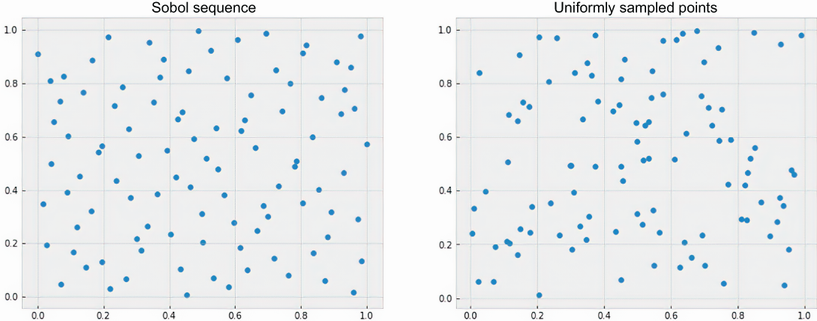
Compare Sobol and uniformly sampled points in a two-dimensional unit square; the more even Sobol coverage motivates its use for candidate generation. section 5.3.2

