How do you decide what to think about yourself or the world? One way is to look at what others think. Social comparison theory describes how people form opinions and evaluate themselves by comparing with others, rather than in isolation. section 8.1.1
Social comparison is related to, but distinct from, social identity theory: comparison concerns how we evaluate ourselves and our opinions, while social identity concerns how identifying with a group shapes our relationship to its members. On social media, groups can be arbitrarily defined, raising questions about whom people compare themselves with. section 8.1.1
Figure 8.1 An example of how the shape of the network, i.e., its connections, influences the flow of information. In diagram A, the circle nodes are better connected than the square ones. Because of that, the square nodes would receive more information from the circular ones, giving the impression that their opinion is the majority. In contrast, a different network shape, shown on the right, can lead to a very different spread of information where the square nodes receive the majority of their information from other square nodes.
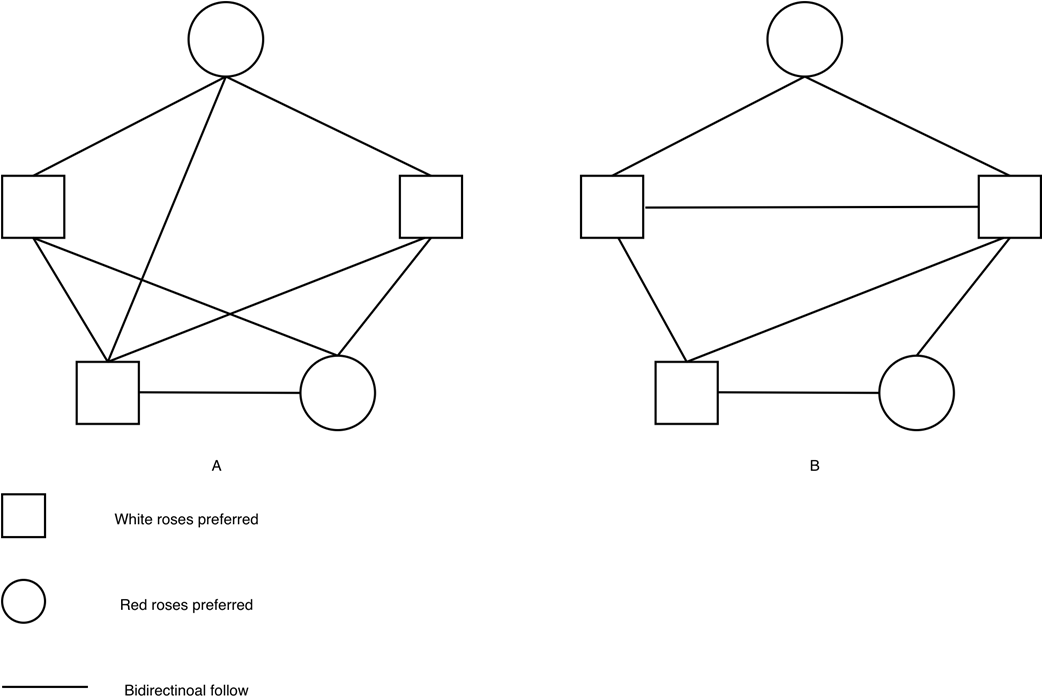
The network diagrams show how connections can change which opinions people encounter and which opinion appears to be the majority. section 8.1.1
